


[Dec-2025] Cisco 300-420 Test Engine PDF - All Free Dumps from Pass4guide
Get New 300-420 Certification – Valid Exam Dumps Questions
NEW QUESTION # 145
Refer to the exhibit.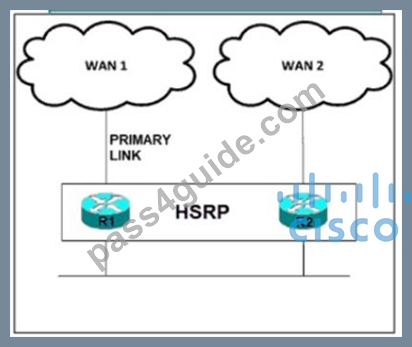
Refer to the exhibit. An engineer must design an automatic failover solution. The solution should allow HSRP to detect a WAN 1 failure and initiate an automatic failover, making router R2 the active HSRP router. Which two solutions should the engineer choose? (Choose two.)
- A. use a floating static route
- B. Implement IP SLA on router R1
- C. Implement Enhanced Object Tracking on router R1
- D. use IP source routing
- E. Implement PBR on router R1
Answer: B,C
NEW QUESTION # 146
What is the purpose of service routes in OMP updates?
- A. describe underlay transport information
- B. indicate services that are enabled for service insertion
- C. define the remote management information
- D. specify routes toward a centralized orchestration plane
Answer: B
NEW QUESTION # 147
An engineer must peer with an ISP for internet connectivity using BGP, initially, the engineer wants to receive only specific prefixes from the ISP and a default route. However, the solution must provide the flexibility to add prefixes in the future at short notice. The ISP has a two-week change process in place. Which route filtering solution must the engineer employ?
- A. Request only the required prefixes and default route be advertised from the ISO with whitelisted networks
- B. Request a limited internet routing table and a default route from the ISP and configure the BGP max-limit to 1 with an access list that permits only the specific internet prefixes and blocked networks
- C. Configure outbound route filtering on the enterprise and ISP so that the enterprise tell the ISP which prefixes are required
- D. Request a full internet routing table and a default route from the ISP and configure inbound route filtering with a prefix list that permits the default route and required prefixes
Answer: D
Explanation:
anychange on the prefix list, engineer only need to update the preifx list and restart the BGP peer to the ISP. soft-reconfiguration inbound could be used to reduce down time of reset BGP peer, but it require lots of memory and in this case, connection to ISP and tons of route learnt will not be apporitated.
NEW QUESTION # 148 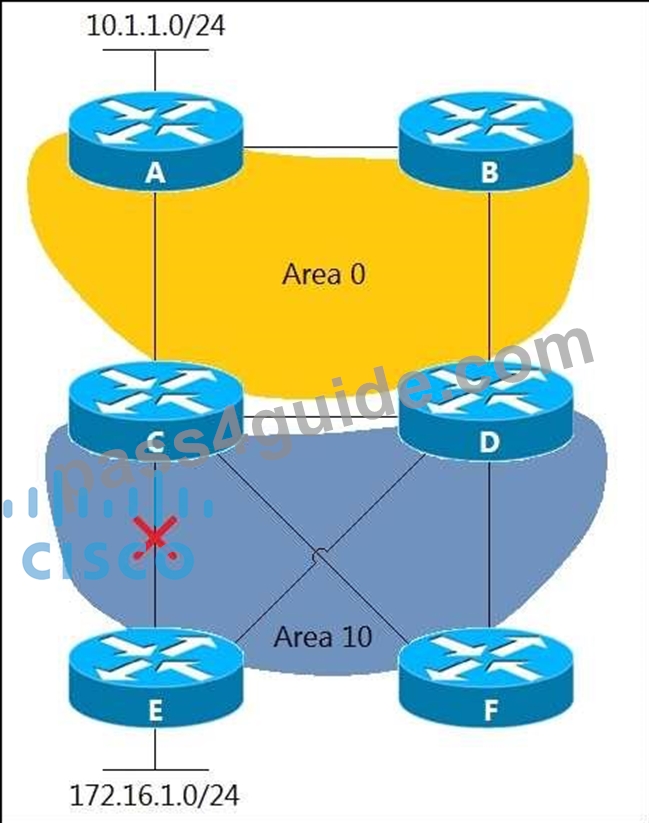
Refer to the exhibit. Area 10 is a regular OSPF area and networks 10.1.1.0/24 and 172.16.1.0/24 are internal.
Which design provides optimal routing between both networks when the link between routers C and E fails?
- A. Make area 10 a not-so-stubby area.
- B. Move the link between routers C and D to area 10.
- C. Create an OSPF virtual link between routers E and F.
- D. Create a tunnel between routers E and F in area 10.
Answer: B
Explanation:
Section: Advanced Addressing and Routing Solutions
Explanation/Reference:
NEW QUESTION # 149
An engineer is tasked with designing a dual BGP peering solution with a service provider. The design must meet these conditions:
* The routers will not learn any prefix with a subnet mask greater than /24.
* The routers will determine the routes to include in the routing table based on the length of the mask alone.
* The routers will make this selection regardless of the service provider configuration.
Which solution should the engineer include in the design?
- A. Use an IP prefix list to block the desired networks and apply the IP prefix list to BGP neighbors outbound.
- B. Use a route map and prefix list to block the desired networks, and apply the route map to BGP neighbors outbound.
- C. Use an IP prefix list to block the desired networks and apply the IP prefix list to BGP neighbors inbound.
- D. Use a route map and access list to block the desired networks, and apply the route map to BGP neighbors inbound.
Answer: C
NEW QUESTION # 150
Refer to the exhibit. An engineer working for a telecommunication company with an employee ID:
1234:56:789 is calculating STP scalability for switches to ensure that the numbers are below the maximum supported value for STP logical ports. How many logical interfaces are active for switch A?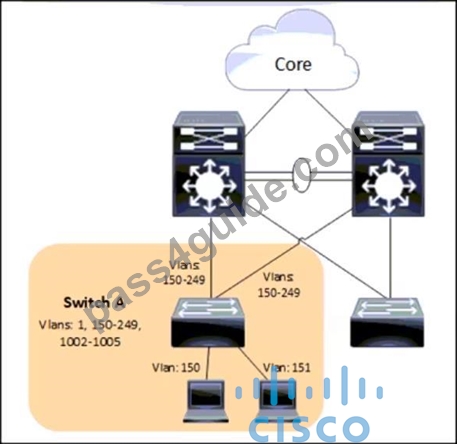
- A. 0
- B. 1
- C. 2
- D. 3
Answer: B
Explanation:
When designing a large data center using extended Layer 2 VLAN topologies, it is necessary to calculate the spanning tree logical and virtual ports in advance to ensure that spanning tree operates with optimal convergence and stability characteristics.
trunks on the switch * active VLANs on trunks + number of non-trunking interfaces on the switch
2 Trunks * 100 Vlans + 2 = 202 Active Logical Interfaces
NEW QUESTION # 151
An organization plans to deploy multicast across two different autonomous systems. Their solution must allow RPs to:
*discover active sources outside their domain
*use the underlying routing information for connectivity with other RPs
*announce sources joining the group
Which solution supports these requirements?
- A. PIM-SM
- B. PIM-DM
- C. SSM
- D. MSDP
Answer: D
Explanation:
Explanation
https://www.cisco.com/c/en/us/td/docs/ios-xml/ios/ipmulti_pim/configuration/xe-3s/asr903/imc-pim-xe-3s-asr90
NEW QUESTION # 152
What is the purpose of a control plane node in a Cisco SD-Access network fabric?
- A. to identify and authenticate endpoints within the network fabric
- B. to maintain the endpoint database and mapping between endpoints and edge nodes
- C. to detect endpoints in the fabric and inform the host tracking database of EID-to-fabric-edge node bindings
- D. to act as the network gateway between the network fabric and outside networks
Answer: C
NEW QUESTION # 153 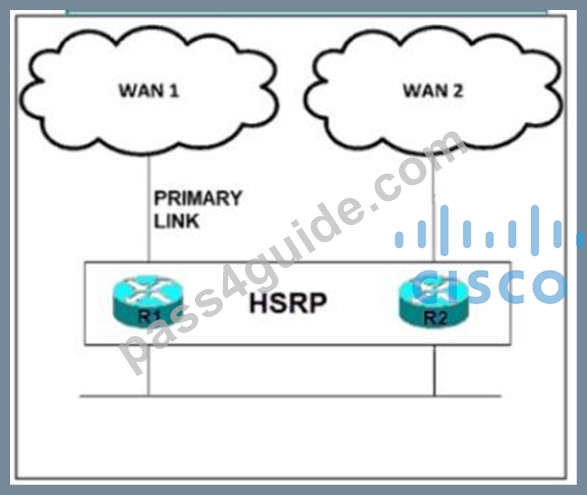
Refer to the exhibit. An engineer must design an automatic failover solution. The solution should allow HSRP to detect a WAN 1 failure and initiate an automatic failover, making router R2 the active HSRP router. Which two solutions should the engineer choose? (Choose two.)
- A. use a floating static route
- B. Implement IP SLA on router R1
- C. Implement Enhanced Object Tracking on router R1
- D. use IP source routing
- E. Implement PBR on router R1
Answer: B,C
NEW QUESTION # 154
Refer to the exhibit. Which solution decreases the EIGRP convergence time?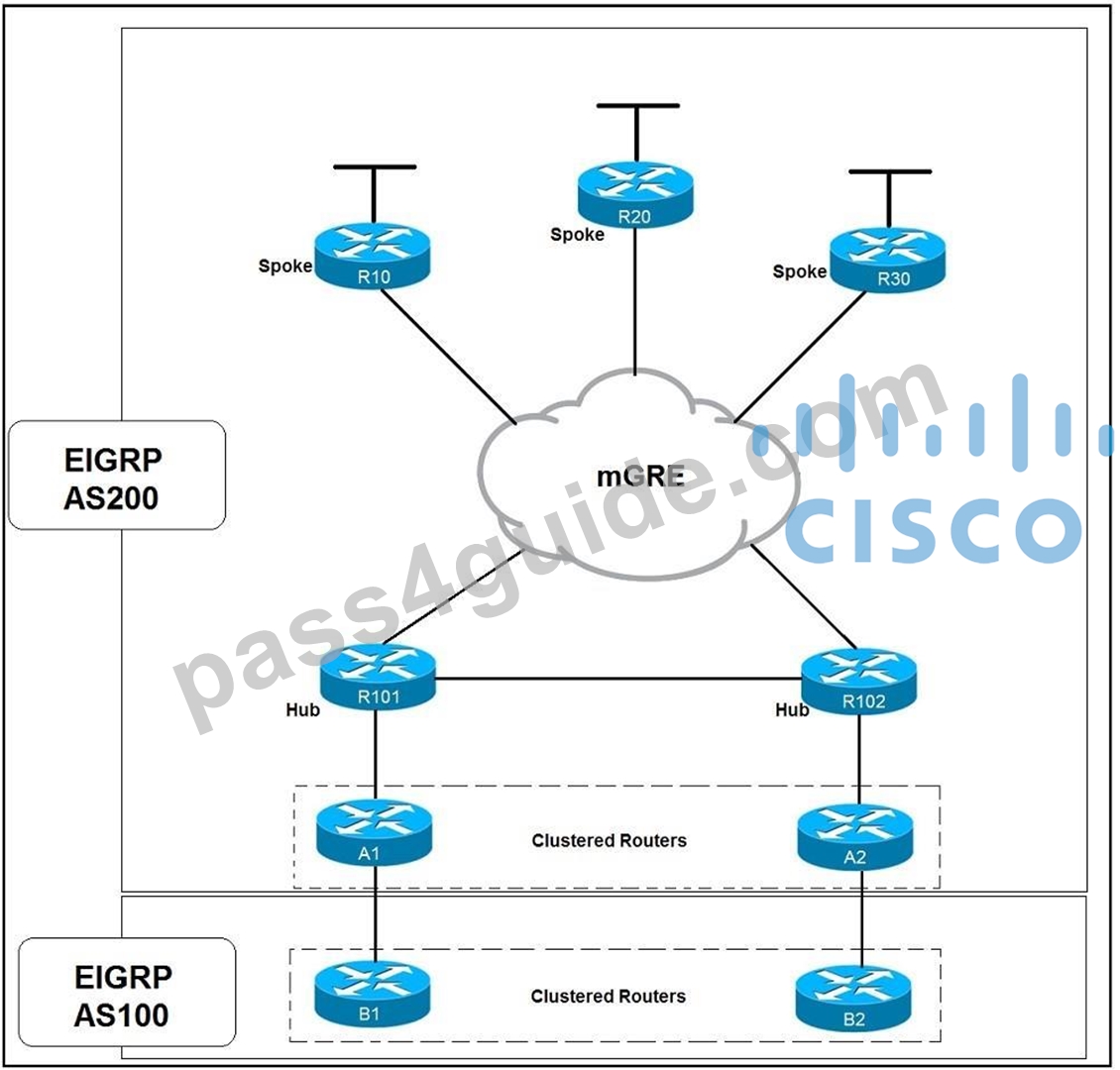
- A. Enable subsecond timers
- B. Increase the hold time value
- C. Increase the dead timer value
- D. Enable stub routing on the spokes
Answer: D
Explanation:
Query storms are eliminated, which saves bandwidth and CPU and allows the network to converge more quickly.
https://www.cisco.com/en/US/technologies/tk648/tk365/technologies_white_paper0900aecd8023 df6f.html
NEW QUESTION # 155
An architect must design a topology for a WAN network that satisfies these requirements:
- Devices must be able to make informed decisions.
- Suboptimal paths are allowed only in case of a failure.
- Backup paths must always be available.
Which topology must the architect select?
- A. partial mesh
- B. Clos
- C. hub and spoke
- D. full mesh
Answer: D
NEW QUESTION # 156 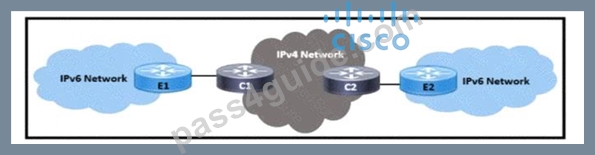
Refer to the exhibit. An architect is designing an ISIS network for a customer migrating from IPv4 to IPv6.
The current network uses narrow metrics, and the IPv6 areas will increase to 10 within the next two years.
Also, IPv6 traffic must not blackhole in IPv4 network during the migration. Which two solutions must the architect choose? (Choose two.)
- A. metric-style transition enabled on all routers
- B. multi-topology enabled under address-family ipv6 on C1 and C2
- C. metric-style transition enabled on E1 and E2
- D. metric-style transition enabled on C1 and C2
- E. multi-topology enabled under address-family ipv6 on E1 and E2
Answer: C,E
NEW QUESTION # 157
Refer to the exhibit.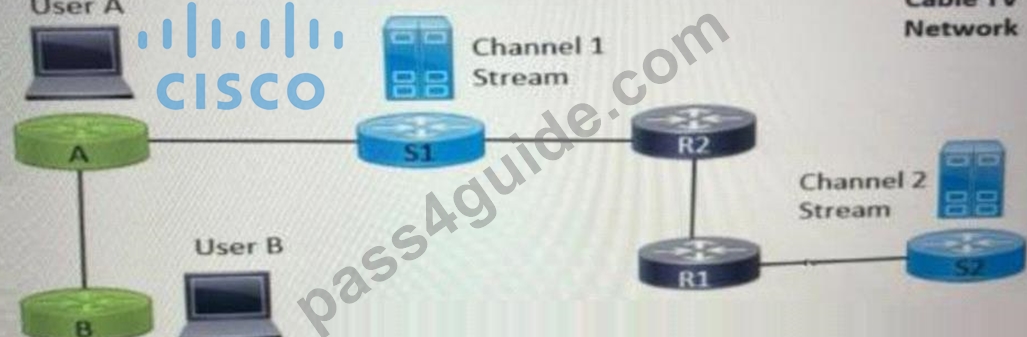
A network engineer must design a multicast solution based on:
* Many-to-many communications between the users and sources
* Support of up to 50 multicast sources
* Users that must register for steams
Which multicast solution must the engineer select?
- A. Multicast VPN
- B. Bidirectional PIM
- C. Any Source Multicast
- D. Source-Specific Multicast
Answer: B
NEW QUESTION # 158 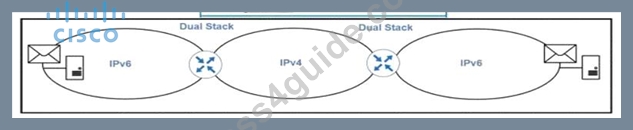
Refer to the exhibit. Which method must an architect use to provide connectivity between the mail servers?
- A. ISATAP
- B. 6rd
- C. 6to4
- D. IPv4 compaliDie
Answer: D
NEW QUESTION # 159
An engineer must design a multicast network for a financial application. Most of the multicast sources also receive multicast traffic (many-to-many deployment model). To better scale routing tables, the design must not use source trees. Which multicast protocol satisfies these requirements?
- A. PIM-SSM
- B. BIDIR-PIM
- C. MSDP
- D. PIM-SM
Answer: D
Explanation:
Section: Network Services
NEW QUESTION # 160
An engineer is upgrading a company's main site to include a connection to a second ISP. The company will receive full Internet routing tables from both ISPs via BGP. The engineer must ensure that the company does not become a transit autonomous system. Which solution should be included in this design?
- A. Lower the MED for updates sent to the secondary ISP.
- B. Modify the local-preference for routes incoming from the primary ISP.
- C. Tag incoming routes from both ISPs with BGP community no-export.
- D. Use a route-map to prevent all prefixes from being advertised to either ISP.
Answer: C
Explanation:
There are 4 methods how you can prevent becoming a transit AS:
- Filter-list with AS PATH access-list.
- No-Export Community.
- Prefix-list Filtering
- Distribute-list Filtering
https://networklessons.com/bgp/bgp-prevent-transit-as
NEW QUESTION # 161
Drag and drop the characteristics from the left onto the YANG modules they describe on the right. Not all options are used.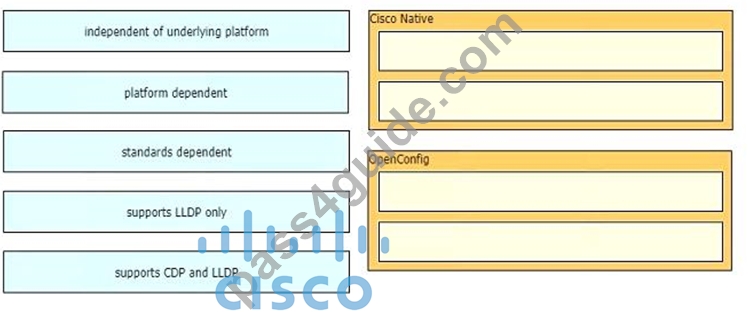
Answer:
Explanation: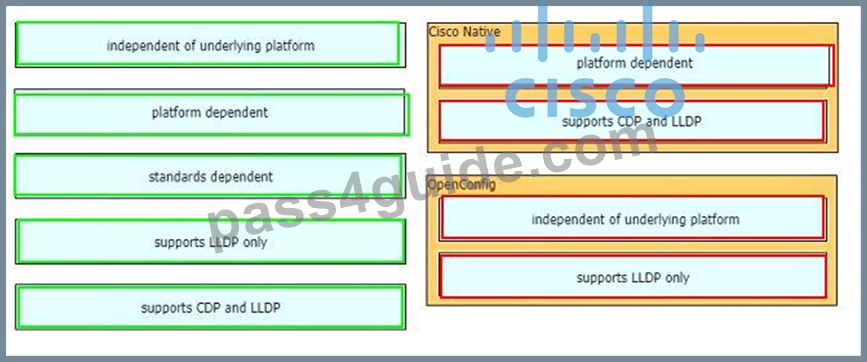
NEW QUESTION # 162
Which function do reverse path forwarding mechanisms perform in a multicast deployment?
- A. They notify the upstream routerof multicast traffic.
- B. They eliminate overlapping multicast addresses
- C. They send PIM prune message toward multicast sources.
- D. They prevent loops and duplicate packets.
Answer: D
Explanation:
Explanation
Reverse path forwarding (RPF) mechanisms are used to prevent loops and duplicate packets in multicast deployments [1]. The RPF check verifies that all multicast traffic received on a router is sourced from the expected direction, ensuring that multicast traffic is not looped back in the network. The RPF check works by comparing the source IP address of a multicast packet with the routing table, and only forwarding it if it matches the expected entry.
NEW QUESTION # 163
What is the purpose of a border node in a Cisco SD-Access fabric?
- A. expand a network
- B. perform network virtualization
- C. connect devices to a network
- D. perform traffic encapsulation and de-encapsulation
Answer: D
NEW QUESTION # 164
An architect must address sustained congestion on the access and distribution uplink of network.
QoS has already been implemented and optimized, but it is no longer effective in ensuring optimal network performance.
Which two solutions should the architect use to improver network performance? (Choose two)
- A. Bundle additional uplinks into logical EtherChannels
- B. Utilize random early detection to manage queues
- C. Implement higher-speed uplink interfaces
- D. Configure selective packet discard to drop noncritical network traffic.
- E. Reconfigure QoS based on the IntServ model
Answer: A,C
NEW QUESTION # 165 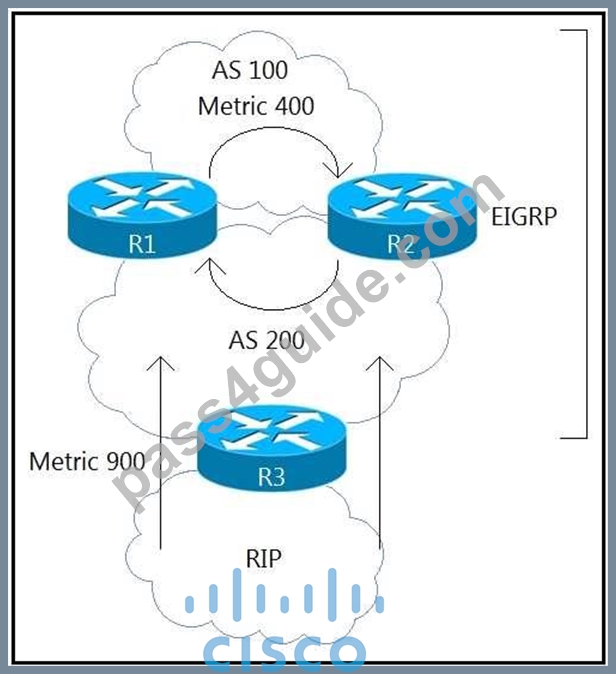
Refer to the exhibit. An architect must design a solution to connect the network behind R3 with the EIGRP network. Which mechanism should be included to avoid routing loops?
- A. down bit
- B. route tags
- C. summarization
- D. split horizon
Answer: B
Explanation:
Section: Advanced Addressing and Routing Solutions
NEW QUESTION # 166
Which AES mode should be used in a Cisco SD-WAN environment that includes multicast applications?
- A. Electronic Code Book (ECB)
- B. Cipher Feedback (CFB)
- C. Cipher Block Chaining (CBC)
- D. Galois/Counter Mode (GCM)
Answer: D
NEW QUESTION # 167 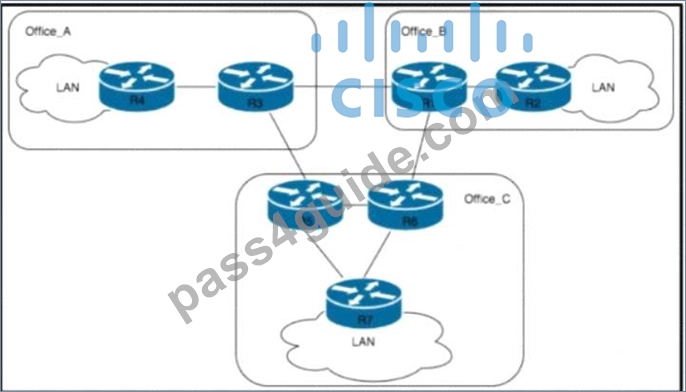
Refer to the exhibit. A company has some offices that are connected via dark fiber in New York. A network architect must optimize the network design based on the EIGRP routing protocol. The network has hierarchical addressing between 10 and 12 routers in each office. Routing convergence time must be at the minimum. What must the network architect do to reduce the query range?
- A. Configure stub areas on non-edge routers.
- B. Configure route filtering on non-edge routers.
- C. Implement network summarization on edge routers.
- D. Use different EIGRP processes on edge routers.
Answer: C
NEW QUESTION # 168
......
100% Passing Guarantee - Brilliant 300-420 Exam Questions PDF: https://www.pass4guide.com/300-420-exam-guide-torrent.html
300-420 Dumps 2025 - NewCisco Exam Questions: https://drive.google.com/open?id=1T24T1mt6qb6lwFLnE1BsOScr1lRIbenT