


Free Salesforce Consultant Analytics-Con-201 Ultimate Study Guide (Updated 117 Questions)
Get to the Top with Analytics-Con-201 Practice Exam Questions
NEW QUESTION # 17
A consultant is tasked with creating a dataset and a dashboard for a sales team. During the requirements gathering, it was highlighted that security of the data is important.
It was noted that the Opportunity object has organization-wide defaults set to Private with access via the role hierarchy. Sales wants to keep this security in place for the dashboard. Looking at theOpportunity data, the consultant sees that the VP of sales can have access to up to 20,000 records and is unsure if sharing inheritance can be used.
Which approach ensures data security for the new Opportunity dataset?
- A. Flatten the role hierarchy in the dataflow recipe and set a security predicate based on Opportunity owner and role path.
- B. Run the Sharing Inheritance Coverage Assessment for the Opportunity object in the analytics settings.
- C. Enable Inherit Sharing from Salesforce in the analytics settings and set Opportunity as the source on the dataset.
Answer: B
Explanation:
For ensuring that the security settings on the Opportunity object are appropriately replicated in the CRM Analytics environment, running the Sharing Inheritance Coverage Assessment is an effective strategy. Here's why:
* Assessment of Inheritance Feasibility: This tool assesses whether sharing rules on the Opportunity object can be effectively inherited in the analytics environment, ensuring that the organization-wide defaults and role hierarchy are maintained.
* Identification of Limitations: The assessment will identify any potential issues or limitations with inheriting sharing settings due to the large number of records (up to 20,000 for the VP of Sales), providing clear insights on how to proceed.
* Guided Decision Making: Based on the outcome of the assessment, the consultant can make informed decisions about whether to directly inherit sharing or consider alternative strategies like flattening the role hierarchy or using security predicates.
NEW QUESTION # 18
A manager at Cloud Kicks asks for data in a dashboard to be refreshed after the sync of an external connection to Google BigQuery.
How should the consultant accomplish this?
- A. Create 3 Salesforce flow to trigger the recipe to run once the connection sync has finished running.
- B. Schedule the recipe to run as event-based and check the Salesforce external connection syncs checkbox.
- C. Check the scheduled date/time of the sync and schedule the recipe to run 15 minutes after the start time of the sync.
Answer: B
Explanation:
For Cloud Kicks' requirement to refresh dashboard data synchronously with the sync of an external connection to Google BigQuery, the most efficient method is:
* Event-Based Triggers: Using CRM Analytics, you can set up recipes to run on an event-based trigger.
This ensures that the recipe (which processes the data for the dashboard) only runs after the external data sync is completed.
* Salesforce External Connection Syncs: By specifically targeting the synchronization event of the Salesforce external connection with Google BigQuery, the recipe ensures data consistency and timeliness without manual intervention.
* Automation and Efficiency: This approach minimizes latency and maximizes data freshness, aligning data processing closely with data availability, thus enhancing dashboard accuracy.
NEW QUESTION # 19
A CRM Analytics administrator is working on deploying a dataflow and a dataset (generated by this dataflow) to another org.
While creating a change set, they notice that the components are NOT visible to be included in the change set.
What is the reason for this?
- A. Assets are kept in the Private App and are unavailable to include in the change set.
- B. The administrator does NOT have access to the assets on CRM Analytics.
- C. The administrator does NOT have system administrator permission to include the assets In the change set,
Answer: A
NEW QUESTION # 20
Universal Containers (UC) has a "Sales Manager" dashboard. UC has a compare table that has multiple groupings and columns added showing the Total and Subtotals of the numeric values. A consultant is asked to add additional groups to enhance details about UC's customers.
Which feature should the consultant use to make the navigation of the compare tables easier for the end user?
- A. Select the Enable Expand or Collapse option from the table properties.
- B. Create the table using SAQL query to accommodate this and make It user friendly.
- C. Scroll to the very end to see the details.
Answer: A
NEW QUESTION # 21
Universal Containers (UC) is rolling out CRM Analytics to its field sales that include dashboards withorder data from an external source.
UC has a well-defined role hierarchy where everyone is assigned to an appropriate node on the hierarchy. In addition, the order data has a reference to a Salesforce opportunity.
An individual sales rep should be able to view all orders that they own or as part of the account team or opportunity team. The sales manager should be able to view all orders for the entire sales team. Similarly, the VP of sales should be able to view orders for everyone who rolls up in that hierarchy.
The dataset has a field called Ownerld which represents the order owner.
Given this information, how should a CRM Analytics consultant implement the above requirements?
- A. As part of the recipe, use the flatten operation on the role hierarchy, create a multi-value attribute called
'ParentRoleIDs' on the dataset, and apply the following security predicate: 'ParentRoleIDs' == "$User.
UserRoleld" || 'TeamMember.Id' '$User, Id" || 'Ownerld' == "$User.Id". - B. As part of the recipe, use a formula on the Roleid fildto create an attribute called 'ParentRolelDs' on the dataset, and apply the following security predicate: 'ParentRolelDs' ==''$UserRoleId'' || Owned\ ==
'$User,id\\, - C. As part of the recipe, use a multi row formula on the Roleld field to create an attribute called
'ParentRoleIDs' on the dataset, and apply the following security predicate:"$User.UserRoleld" ||
'Ownerld' == "$User.Id".
Answer: A
Explanation:
In addressing the requirements of Universal Containers to ensure proper visibility of order data across different levels of the sales hierarchy, the use of a security predicate based on role hierarchies is paramount.
Here's why Option B is the ideal approach:
* Flatten Operation on Role Hierarchy: This operation is essential as it allows for the creation of a simplified or "flattened" view of the hierarchical relationships within the organization. This flattened view enables the dataset to understand and respect the hierarchical structure in security implementations.
* Creating a Multi-value Attribute ('ParentRoleIDs'): By creating this attribute, the recipe can hold multiple role IDs that a particular user has visibility permissions for. This is crucial in a hierarchical organization like UC where data visibility needs to cascade down the hierarchy.
* Security Predicate: The predicate ('ParentRoleIDs' == "$User.UserRoleld" || 'TeamMember.Id' ==
'$User.Id' || 'Ownerld' == "$User.Id") effectively enforces that:
* A user can see all orders where their role matches any of the role IDs in the 'ParentRoleIDs' list (hierarchical visibility).
* A user can see all orders where they are specifically listed as a team member.
* A user can see all orders where they are the owner.
This approach aligns with best practices for implementing row-level security in CRM Analytics, ensuring data visibility is managed correctly according to the defined organizational hierarchy and individual data ownership.
NEW QUESTION # 22
Universal Containers has a dashboard for sales managers. They need the ability to visualize the number of Closed Won opportunities by month, quarter, or year, and then display the result in a single chart. A CRM Analytics consultant creates a custom query to display three values:
ClosedDate_month, ClosedDate_ quarter, and ClosedDate_year.
What should the consultant do next?
- A. Use result binding/interaction to update the grouping in the chart.
- B. Use selection binding/interaction to update the measure In the chart.
- C. Use selection binding/interaction to update the grouping In the chart.
Answer: C
NEW QUESTION # 23
A CRM Analytics consultant is adding direct data into an existing recipe. When trying to click on the input node, data preview is taking a long time to show any results.
How should the consultant resolve this?
- A. Register the Salesforce object and use Filtered Rows under Data Preview Sampling.
- B. Use the Filtered Rows sampling mode under Data Preview Sampling to filter records.
- C. Update the Sample Size under Data Preview Sampling to 5,000 rows.
Answer: B
NEW QUESTION # 24
Which recommended technique should a CRM Analytics consultant
use to access CRM Analytics data from a remote app or website?
- A. Use HTTPS to call the /wave/query API, supplying an encoded SAQL query asa parameter.
- B. Export the data to a CSV file and load it on the remote site.
- C. Use an iFrame to embed the Salesforcepage in a remote site.
Answer: A
NEW QUESTION # 25
Exhibit.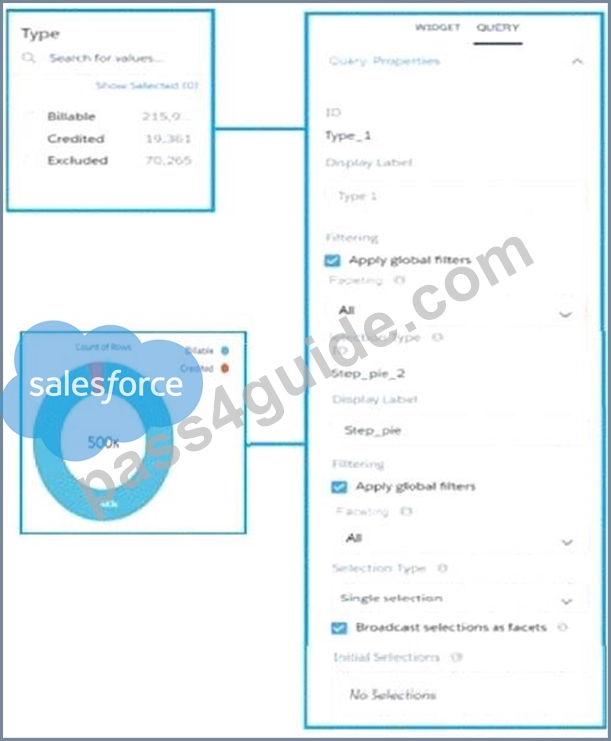
Given that the queries are using different datasets, which change should a CRM Analytics consultant make to solve this issue?
- A. Use "Connect Data Sources" and create a connection to connect the two widgets.
- B. Use "Connect Data Sources" and create a connection to connect the two datasets.
- C. Use result binding/Interaction in the filters section of the query "Type 1".
Answer: B
NEW QUESTION # 26
Universal Containers (UC) is using CRM Analytics to create two datasets.
* Dataset A: Contains a list of activities with an "activityID" dimension and a "userID" dimension
* Dataset B: Contains a list of users with a "userID" dimension
UC wants to delete all activities from Dataset A related to users in Dataset B.
How should the CRM Analytics consultant help UC achieve this?
- A. Use the recipe node "delete" and set "userID" as the deletion ID.
- B. Use the combination of recipe transformations: "join" and "filter".
- C. Use the "update" transformation and utilize the "filter" node.
Answer: B
NEW QUESTION # 27
A consultant creates a CRM Analytics dashboard in a sandbox and it needs to be migrated into production.
What should the consultant use to complete the migration?
- A. Change sets
- B. Analytics dashboard connector
- C. Analytics External Data API
Answer: A
NEW QUESTION # 28
The administrator at Cloud Kicks has been asked to sync data from an external object created in Salesforce into CRM Analytics.
What should the administrator keep in mind?
- A. Salesforce external objects are unsupported in RM Analytics recipes digest transformations.
- B. Loading the external object data into CRM Analytics will help joinobjects in the recipes.
- C. Using a custom connector to connect to the external objects will load it into CRM Analytics.
Answer: A
NEW QUESTION # 29
Which statement best describes how to ensure CRM Analytics dashboards are easily used across both desktop and mobile devices?
- A. Create multiple layouts and reorder all the widgets so that they fit nicely within the new default width
- B. Create multiple layouts, ensure the layout selectors match the device, and resize/hide widgets to ensure the content is appropriate for the device screen size.
- C. Create multiple layouts and allow CRM Analytics to automatically select and organize dashboard contents to be optimal for the device type.
Answer: B
Explanation:
To ensure that CRM Analytics dashboards are optimally usable on both desktop and mobile devices, creating multiple layouts tailored to each device type is crucial. Here's why Option C is the best approach:
* Device-Specific Layouts: By creating specific layouts for each device type, you ensure that the dashboard contents are presented in a manner best suited to the screen size and interaction model of the device.
* Layout Selectors: These are used to automatically display the appropriate layout based on the device accessing the dashboard, enhancing user experience without manual intervention.
* Widget Customization: Resizing or hiding certain widgets for specific device layouts ensures that the dashboard remains clean, uncluttered, and easy to navigate, regardless of the device used.
NEW QUESTION # 30
Universal Containers uses CRM Analytics to build dashboards for different departments: Sales, Service, and Marketing. Users in the samedepartment have the same role and need to have access to the same dashboards.
Dashboards for different departments use some common datasets with the same row-level security.
How should a CRM Analytics consultant address this need?
- A. Create one app for each department, put common datasets in the shared app, and use profiles to share apps.
- B. Create one app for each department, put common datasets in the shared app, and use roles to share apps.
- C. Create one app for each department, put common datasets in the shared app, and use permission sets to share apps.
Answer: C
Explanation:
For managing access to department-specific dashboards while leveraging common datasets, the best approach involves the use of apps and permission sets. Here's why:
* App Segregation: Creating a separate app for each department (Sales, Service, Marketing) allows for tailored dashboards and datasets to be grouped by department, facilitating easier management and navigation.
* Shared Common Datasets: Placing common datasets in a shared app ensures that all departments can access necessary data without duplication, maintaining consistency and reducing storage requirements.
* Use of Permission Sets: Leveraging permission sets to control access to these apps is a flexible and scalable approach. Permission sets can be finely tuned to grant or restrict access based on user roles within the organization, and they can be easily adjusted as roles or organizational structures change.
This structure not only ensures data security and appropriate access but also enhances the efficiency of managing CRM Analytics resources across different departments.
NEW QUESTION # 31
After getting approval for the dashboard layout design for a desktop, the CRM Analytics consultant is ready to start the design process for a mobile layout.
Which consideration should the consultant keep in mind?
- A. If no layouts are eligible for the mobile device, an error message will be displayed but the dashboard will still be visible on the desktop without errors.
- B. Create a layout with the property "phone" to show the dashboard on the mobile app similar to creating a layout with the property "dashboard"to show on the desktop for thesame dashboard,
- C. "Tablet" or "Phone" layout-where only minWidth and maxWidth have been set-may be displayed on a desktop if the dashboard is embedded in asmall frame, or if the browserwindow is small.
Answer: C
Explanation:
When designing for different device types in CRM Analytics, particularly for mobile layouts, it's crucial to consider how the layout will respond not just on mobile devices but also under various display conditions on desktops. Here's the rationale for focusing on this consideration:
* Responsiveness: Layouts designated for tablets or phones may also be triggered on desktop environments if conditions such as browser window size or embedded frame dimensions mimic those typical of smaller devices.
* Design Flexibility: Understanding this behavior is essential for creating versatile dashboards that maintain functionality and visual integrity across all potential viewing scenarios.
* User Experience: Ensuring that the dashboard behaves predictably across device types and sizes enhances user engagement and effectiveness, as it provides a consistent experience regardless of the access point.
This approach ensures that the dashboard remains functional and accessible no matter how or where it is being viewed, aligning with best practices for responsive and adaptive design in modern analytics environments.
NEW QUESTION # 32
A consultant wants to understand what the important predictors are in a model.
Where is this information found?
- A. Model Deployment Wizard
- B. Einstein Recommendations
- C. Model Settings
Answer: C
Explanation:
The important predictors of a model in CRM Analytics can typically be found under theModel Settings. This area provides detailed information about the configuration and the inputs (predictors) used to train the model.
Insights into which predictors have the most significant impact on the model's outcomes can be gleaned from this section, enabling a deeper understanding of the model's internal workings and the factors driving predictions.
NEW QUESTION # 33
A CRM Analytics consultant has been tasked with providing access to CRM Analytics for a few users. They should be able to view the data but unable to export it.
Which permission should the consultant make sure to NOT include?
- A. View CRM Analytics Assets
- B. Download CRM Analytics data
- C. Export CRM Analytics data
Answer: B
NEW QUESTION # 34
The marketing team at Cloud Kicks has five dashboards in an app. Four widgets are replicas of each other in three of the dashboards.
What is the best way to maintain these widgets?
- A. Create/Edit the widgets individually on each dashboard.
- B. Create/Edit a component for the widgets.
- C. Create/Edit a lens and add each dashboard.
Answer: B
Explanation:
To maintain consistency and ease of updates across multiple dashboards, creating or editing a component for the widgets is the most effective method. This approach:
Efficiency in Updates: Allows changes to be made in one place, which automatically propagates to all instances where the component is used across dashboards.
Consistency: Ensures uniformity in the appearance and functionality of the widgets across different dashboards.
Simplicity: Reduces the need for redundant work, where each widget would otherwise need to be updated individually.
NEW QUESTION # 35
......
Pass Salesforce Analytics-Con-201 exam - questions - convert Tets Engine to PDF: https://www.pass4guide.com/Analytics-Con-201-exam-guide-torrent.html
Use Real Analytics-Con-201 Dumps Free Sample Questions and Practice Test Engine: https://drive.google.com/open?id=12FGbMPb3Pl2psPKMesr-rTJKd2qXnghF