


Nov-2025 Salesforce Salesforce-MuleSoft-Developer-I Actual Questions and 100% Cover Real Exam Questions
Salesforce-MuleSoft-Developer-I Free Exam Questions and Answers PDF Updated on Nov-2025
Salesforce Salesforce-MuleSoft-Developer-I Exam Syllabus Topics:
| Topic | Details |
|---|---|
| Topic 1 |
|
| Topic 2 |
|
| Topic 3 |
|
| Topic 4 |
|
| Topic 5 |
|
| Topic 6 |
|
| Topic 7 |
|
NEW QUESTION # 140
What payload is returned by a Database SELECT operation that does not match any rows in the database?
- A. Empty Array
- B. null
- C. Exception
- D. false
Answer: A
Explanation:
Empty array is returned when no rows are matched.
MuleSoft Doc Ref : https://docs.mulesoft.com/db-connector/1.9/database-connector-select
NEW QUESTION # 141
Refer to the exhibits.
This main mule application calls a separate flow called as ShippingAddress which returns the address corresponding to the name of the user sent to it as input. Output of this ShippingAddress is stored in a target variable named address.
Next set of requirement is to have a setPayload transformer which will set below two values
1) orderkey which needs to set to be equal to the order element received in the original request payload.
2) addressKey which needs to be set to be equal to the address received in response of ShippingAddress flow What is the straightforward way to properly configure the Set Payload transformer with the required data?

A mule application is being developed which will process POST requests coming from clients containing the name and order information. Sample request is as below
- A. 1. 1. {
2. 2. orderkey: "attributes.shippingaddress.order",
3. 3. addresskey: "payload"
4. } - B. 1. 1. {
2. 2. orderkey: "payload.order",
3. 3. addresskey: "address"
4. } - C. 1. 1. {
2. 2. orderkey: "attributes.order",
3. 3. addresskey: "vars.address"
4. } - D. 1. 1. {
2. 2. orderkey: "payload.order",
3. 3. addresskey: "vars.address"
4. 4. }
Answer: D
Explanation:
Correct answer is as below. In this case address will be stored in a variable. Hence payload will not be overwritten and will contain order details
{
orderkey: "payload.order",
addresskey: "vars.address"
}
NEW QUESTION # 142
Refer to the exhibit. The input array of strings is passed to the batch job, which does NOT do any filtering or aggregating. What payload is logged by the Logger component?
- A. [ "Apple", "Banana" ]
- B. [ "Apptel2", "Bananal2" ]
- C. [ "Apptel", "Bananal", 2 ]
- D. Summary report of processed records
Answer: D
NEW QUESTION # 143
Refer to the exhibit.

How should be the where clause written for the configured input parameters in such a way that it achieves below SQL query?
- A. WHERE city = attributes.city AND state = attributes.state
- B. WHERE city := city AND state := state
- C. WHERE city := ${city} AND state := ${state}
- D. WHERE city = :city AND state = :state
Answer: D
Explanation:
Correct syntax to use where clause is WHERE city = :city AND state = :state This question validates knowledge on using dynamic queries in DB select operation.
Configure Dynamic Queries in the Select Operation
When you need to parameterize not only the WHERE clause but also parts of the query itself (for example, queries that compare tables that depend on a condition, or complex queries for which the project table columns need to vary), you can configure dynamic queries.
In the following example, you configure a dynamic query by using a full expression with a string in which the table depends on a variable $(vars.table). Although some of the query text is dynamic ("SELECT * FROM $(vars.table)), the WHERE clause still defines the WHERE condition using input parameters: in this case, WHERE name = :name.
In your Studio flow, select the Select operation.
In the operation configuration screen, set the SQL Query Text field to SELECT * FROM $(vars.table) WHERE name = :name.
Set the Input Parameters field to {'name' : payload}.
The following screenshot shows the configuration in Studio:
Figure 3. Dynamic query configuration
In the XML editor, the <db:sql> configuration looks like this:
<set-variable variableName="table" value="PLANET"/>
<db:select config-ref="dbConfig">
<db:sql>#["SELECT * FROM $(vars.table) WHERE name = :name"]</db:sql>
<db:input-parameters>
#[{'name' : payload}]
</db:input-parameters>
</db:select>
You can apply input parameters only to parameters in a WHERE clause. To modify any other part of the query, use the DataWeave interpolation operator.
Mule Ref Doc: Query a Database Examples - Mule 4 | MuleSoft Documentation
NEW QUESTION # 144
Refer to the exhibits.
Each route in the Scatter-Gather sets the payload to the number shown in the label. What response is returned to a web client request to the HTTP Listener?
- A.

- B.

- C.

- D.

Answer: A
Explanation:
Correct answer is as below.
After all processing routes have finished execution, the Scatter-Gather component creates a new Mule event that combines all resulting Mule events from each route, and then passes the new Mule event to the next component in the flow.
{
"0": {
"attributes": ...,
"payload": "100"
},
"1": {
"attributes": ...,
"payload": "200"
}
}
Bottom of Form
NEW QUESTION # 145
Refer to the exhibit.
The default scope in choice router recursively calls the color flow.
A web client sends a PUT request to the HTTP listener with payload Blue.
What response is returned to the web client?
- A. ["Blue", "Red", "Blk"]
- B. "Blk"
- C. A timeout error
- D. "Green"
Answer: C
Explanation:
Sequence can be described as follows.
* When web client sends the request , it sends payload as Blue (mentioned in question)
* In first iteration this will go to default choice , which sets payload to Red
* Via default route , flow will call itself with payload as Red
* In second iteration , as payload is Red , it will go to first route in choice router which will set payload to Blk and second iteration will end returning back payload as Blk to first iteration.
* This Blk will be again set to payload and first iteration will end returning back response as Blk
NEW QUESTION # 146
Refer to the exhibit.


What payload is returned from a request to http//localhost.8081/
Refer to the exhibits, what payload is returned from a request to http://localhost;8081/?
- A. 0
- B. 1
- C. 2
- D. 3
Answer: A
Explanation:
The flow can be described as below. 1) First HTTP POST requets is made in which paylaod is set to 1 and it gets returned to our mail flow. 2) Second call is initiated for JMS Publish Consume JMS: num1 which add 1 to the payload which makes it as 2. Note that pubih consume is a synchronous operation. Hence paylaod is returned to main flow. 3) Third call is initiated for JMS Publish JMS: num2 which add 1 to the payload . Note that pubih is asynchronous operation. Hence paylaod is never returned to main flow. So payload in main flow is still 2. 4) Finally Set Payload increments payload by 1 making payload as 3 which is returned by the flow. Hence option 3 is the correct answer.
NEW QUESTION # 147
Refer to the exhibits. What payload is logged at the end of the main flow?
- A. [order1, order2, order3, order4]
- B. [1, 2, 3, 4]
- C. order4
- D. order1order2order3order4
Answer: B
Explanation:
For Each Scope
The For Each scope splits a payload into elements and processes them one by one through the components that you place in the scope. It is similar to a for-each/for loop code block in most programming languages and can process any collection, including lists and arrays. The collection can be any supported content type, such as application/json, application/java, or application/xml.
General considerations about the For Each scope:
By default, For Each tries to split the payload. If the payload is a simple Java collection, the For Each scope can split it without any configuration. The payload inside the For Each scope is each of the split elements. Attributes within the original message are ignored because they are related to the entire message.
For Each does not modify the current payload. The output payload is the same as the input.
Mule Doc Reference : https://docs.mulesoft.com/mule-runtime/4.3/for-each-scope-concept
NEW QUESTION # 148
What is minimal requirement in a flow for a Mule application to compile?
- A. Source and processors both
- B. Error handlers
- C. Event Source
- D. Event Processors
Answer: D
Explanation:
Process section is must to get compiles. Process section must have one or more processors
NEW QUESTION # 149
Refer to the exhibits. Client sends the request to ClientRequestFlow which calls ShippingFlow using HTTP Request activity.
During E2E testing it is found that that HTTP:METHOD_NOT_ALLOWED error is thrown whenever client sends request to this flow.
What attribute you would change in ClientRequestFlow to make this implementation work successfully?


- A. Change the allowed method attributes value to "POST"
- B. Change the method attribute value to "*''
- C. Change the protocol attribute value to "HTTPS"
- D. Change the path attribute value to "/api/ship"
Answer: A
Explanation:
Correct answer is Change the method attributes value to "POST".
It can be fixed in either of the two ways as below.
1) Changing method attribute to POST in ClientRequestFlow
2) Setting allowedMethods as PUT in ShippingFlow (but doesn't fit as question mentions about changing ClientRequestFlow)
NEW QUESTION # 150
Refer to the exhibits.
As a mulesoft developer, what you would change in Database connector configuration to resolve this error?

- A. Configure the correct database name
- B. Configure the correct table name
- C. Configure the correct host URL
- D. Configure the correct JDBC driver
Answer: D
Explanation:
Correct answer is Configure the correct JDBC driver as error message suggests the same Caused by: java.sql.SQLException: Error trying to load driver: com.mysql.jdbc.Driver : Cannot load class 'com.mysql.jdbc.Driver': [ Class 'com.mysql.jdbc.Driver' has no package mapping for region 'domain/default/app/mule_app'., Cannot load class 'com.mysql.jdbc.Driver': [
NEW QUESTION # 151
Refer to the exhibit.
How many private flows does APIKIT generate from the RAML specification?
- A. 0
- B. 1
- C. 2
- D. 3
Answer: A
NEW QUESTION # 152
Which of the below functionality is provided by zip operator in DataWeave?
- A. Merges elements of two lists (arrays) into a single list
- B. All of the above
- C. Used for sending attachments
- D. Minimize the size of long text using encoding.
Answer: A
Explanation:
Correct answer is Merges elements of two lists (arrays) into a single list MuleSoft Doc Reference : https://docs.mulesoft.com/mule-runtime/4.3/dw-core-functions-zip
NEW QUESTION # 153
Refer to the exhibits.
The mule application implements a REST API that accepts GET request from two URL's which are as follows
1) http://acme.com/order/status
2) http://acme.com/customer/status
What path value should be set in HTTP listener configuration so that requests can be accepted for both these URL's using a single HTTP listener event source?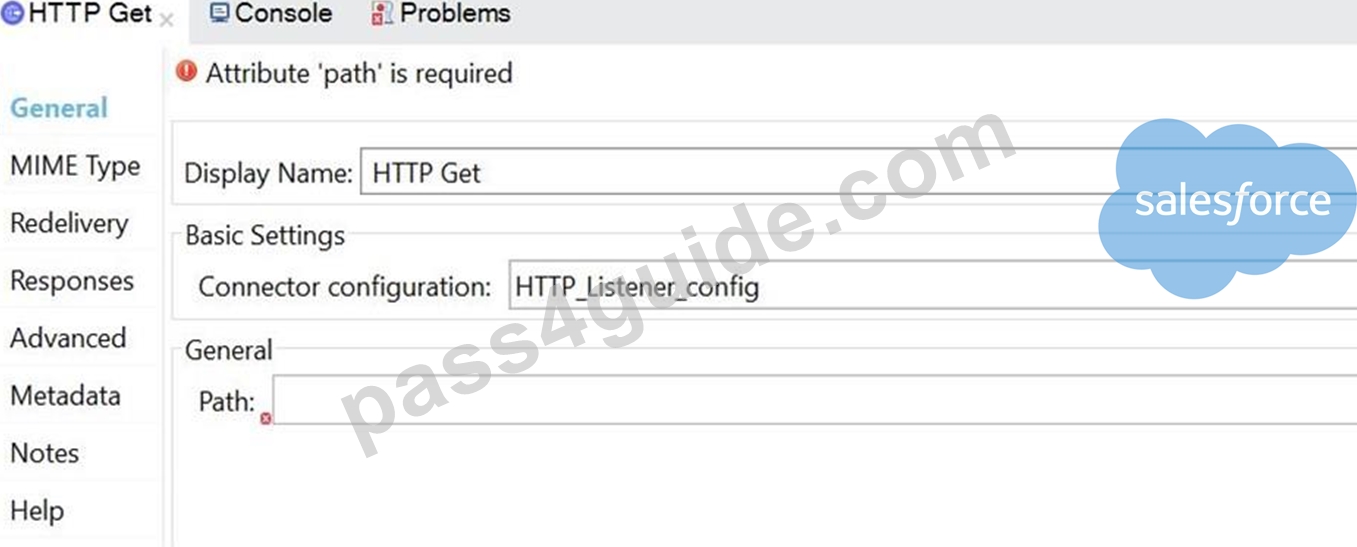
- A. *[order,customer]/status
- B. *status
- C. */status
- D. ?[order,customer]/status
Answer: C
Explanation:
Correct answer is */status as it is the correct way to use wildcards while configuring path value in HTTP listener
NEW QUESTION # 154
How many Mule applications can run on a CloudHub worker?
- A. None of these
- B. Depends
- C. At least one
- D. At most one
Answer: D
NEW QUESTION # 155
Refer to the exhibits.

What payload and quantity are logged at the end of the main flow?
- A. [orderlorder2order3order4,14]
- B. [[1,2,3,4], 10]
- C. [[order1, order2, order3, order4], 14]
- D. [[1,2,3,4], 14]
Answer: D
NEW QUESTION # 156
Refer to the exhibit.
A Mule event is composed of a hierarchy of objects. Where in the hierarchy are variables stored?
- A. Mule message
- B. Mule message payload
- C. Mule message attributes
- D. Mule event
Answer: D
Explanation:
Variables are stored under Mule event. Please refer to below image for the hierarchy .

NEW QUESTION # 157
An API has been created in Design Center. What is the next step to make the API discoverable?
- A. Publish the API from inside flow designer
- B. Deploy the API to a Maven repository
- C. Publish the API to Anypoint Exchange
- D. Enable autodiscovery in API Manager
Answer: C
Explanation:
Correct answer is Publish the API to Anypoint Exchange
Anypoint Exchange makes this possible by making it discoverable in below ways
1) In private exchange for internal developers
2) In a public portal for external developers/clients
Here is diagram created by me to help you understand sequence:
NEW QUESTION # 158
Refer to exhibits.
In the execution of the Scatter-Gather , the flow route completes after 10 seconds and the flow2 route completes in 40 seconds. How many seconds does it take for the Scatter-Gather to complete?
- A. 0
- B. 1
- C. 2
- D. 3
Answer: D
Explanation:
Scatter-Gather sends the event to each routes concurrently. Hence both route in this example will start in parallel. So total time to complete processing is 40 seconds The Scatter-Gather component is a routing event processor that processes a Mule event through different parallel processing routes that contain different event processors. Each route receives a reference to the Mule event and executes a sequence of one or more event processors. Each of these routes uses a separate thread to execute the event processors, and the resulting Mule event can be either the same Mule event without modifications or a new Mule event with its own payload, attributes, and variables. The Scatter-Gather component then combines the Mule events returned by each processing route into a new Mule event that is passed to the next event processor only after every route completes successfully.
The Scatter-Gather component executes each route in parallel, not sequentially. Parallel execution of routes can greatly increase the efficiency of your Mule application and may provide more information than sequential processing.
Mule Ref Doc : https://docs.mulesoft.com/mule-runtime/4.3/scatter-gather-concept
NEW QUESTION # 159
A shopping API contains a method to look up store details by department.
To get the information for a particular store, web clients will submit requests with a query parameter named department and uri parameter named storeId What is valid RAML snippet that supports requests from a web client to get a data for a specific storeId and department name?
- A. 1. get:
2. queryParameter:
3. department:
4. uriParameter:
5. {storeId}: - B. 1. /department:
2. get:
3. uriParameter:
4. storeId: - C. 1. get:
2. uriParameter:
3. {storeId}:
4. queryParameter:
5. department: - D. 1. /{storeId}:
2. get:
3. queryParameter:
4. department:
Answer: D
Explanation:
Lets revise few concepts RAML which can help us to find the answer of this question.
URI Parameters
Lets have a look at below example.
/foos:
/{id}:
/name/{name}:
Here, the braces { } around property names define URI parameters. They represent placeholders in each URI and do not reference root-level RAML file properties as we saw above in the baseUri declaration. The added lines represent the resources /foos/{id} and /foos/name/{name}.
Query Parameters
Now we'll define a way to query the foos collection using query parameters. Note that query parameters are defined using the same syntax that we used above for data types:
/foos:
get:
description: List all Foos matching query criteria, if provided;
otherwise list all Foos
queryParameters:
name?: string
ownerName?: string
Based on the above information , below is the only option which defines storeid as uri parameter and department as query parameter.
/{storeId}:
get:
queryParameter:
department:
NEW QUESTION # 160
What happens to the attributes of a Mule event in a flow after an outbound HTTP Request is made?
- A. New attributes may be added from the HTTP response headers, but no headers are ever removed
- B. Attributes do not change
- C. Previous attributes are passed unchanged
- D. Attributes are replaced with new attributes from the HTTP Request response (which might be null)
Answer: D
Explanation:
Attributes are replaced with new attributes from the HTTP Request response.
Attributes include everything apart from Payload/body. For ex: Headers, query parameters, URI parameters.
So, when outbound HTTP request is made, new attributes need to pass the outbound HTTP request and old attributes are replaced.
I have created below diagram to make it easy for you to understand:
NEW QUESTION # 161
Refer to the exhibit.
What can be added to the flow to persist data across different flow executions?
- A. Key/value pairs in the ObjectStore
- B. session variables
- C. properties of the Mule runtime app object
- D. Properties of the Mule runtime flow object
Answer: A
Explanation:
An object store is a facility for storing objects in or across Mule applications. Mule runtime engine (Mule) uses object stores to persist data for eventual retrieval. Internally, Mule uses object stores in various filters, routers, and other message processors that need to store states between messages.
Object stores are available in all deployment targets. If you deploy your application to CloudHub, you can also use Object Store V2.
Correct answer is Key/value pair in Object store
MuleSoft Documentation reference : https://docs.mulesoft.com/mule-runtime/4.3/mule-object-stores#use-cases
NEW QUESTION # 162
What HTTP method in a RESTful web service is typically used to completely replace an existing resource?
- A. PUT
- B. POST
- C. PATCH
- D. GET
Answer: A
Explanation:
PUT replaces the original version of the resource, whereas the PATCH method supplies a set of instructions to modify the resource
NEW QUESTION # 163
......
Salesforce Salesforce-MuleSoft-Developer-I Real 2025 Braindumps Mock Exam Dumps: https://www.pass4guide.com/Salesforce-MuleSoft-Developer-I-exam-guide-torrent.html
Latest Salesforce-MuleSoft-Developer-I Exam Dumps Recently Updated 237 Questions: https://drive.google.com/open?id=1HJPQ3dnLsgWuyC00tfCzv91Sw5UpUqrh