


Get 100% Real XSIAM-Analyst Exam Questions, Accurate & Verified Answers As Seen in the Real Exam!
XSIAM-Analyst Premium Files Updated Apr-2026 Practice Valid Exam Dumps Question
Palo Alto Networks XSIAM-Analyst Exam Syllabus Topics:
| Topic | Details |
|---|---|
| Topic 1 |
|
| Topic 2 |
|
| Topic 3 |
|
NEW QUESTION # 75
During an investigation of an alert with a completed playbook, it is determined that no indicators exist from the email "[email protected]" in the Key Assets & Artifacts tab of the parent incident. Which command will determine if Cortex XSIAM has been configured to extract indicators as expected?
- A. IcreateNewIndicator value="[email protected]"
- B. !extractIndicators text="[email protected]" auto-extract=inline
- C. !checkIndicatorExtraction text="[email protected]"
- D. Iemailvalue="[email protected]"
Answer: C
Explanation:
The correct answer is C, the !checkIndicatorExtraction text="[email protected]" command.
This command specifically verifies if Cortex XSIAM has been correctly configured to extract indicators from given text. It ensures that the text provided ("[email protected]") would indeed be recognized and extracted as an indicator under the current configuration of Cortex XSIAM.
Other provided commands do not directly verify the indicator extraction configuration:
Option A: IcreateNewIndicator manually creates an indicator; it does not validate extraction capability.
Option B: !extractIndicators attempts extraction immediately but does not verify existing configuration explicitly.
Option D: Iemailvalue command is generally for creating or querying email indicators, not verifying extraction configuration.
Therefore, the explicit functionality for checking if indicator extraction is configured correctly within Cortex XSIAM is precisely covered by !checkIndicatorExtraction.
Reference Extract from Official Document:
"Verify if Cortex XSIAM is correctly configured to extract indicators using the command !
checkIndicatorExtraction text=<value>."
This exact description confirms that option C is the correct answer to validate the configuration explicitly.
NEW QUESTION # 76
A threat hunter discovers a true negative event from a zero-day exploit that is using privilege escalation to launch "Malware pdf.exe". Which XQL query will always show the correct user context used to launch
"Malware pdf.exe"?
- A. config case_sensitive = false | dataset = xdr_data | filter event_type = ENUM.PROCESS | filter action_process_image_name = "Malware.pdf.exe" | fields causality_actor_effective_username
- B. config case_sensitive = false | datamodel dataset = xdrdata | filter xdm.source.process.name = "Malware.
pdf.exe" | fields xdm.target.user.username - C. config case_sensitive = false | dataset = xdr_data | filter event_type = ENUM.PROCESS | filter action_process_image_name = "Malware.pdf.exe" | fields action_process_username
- D. config case_sensitive = false | dataset = xdr_data | filter event_type = ENUM.PROCESS | filter action_process_image_name = "Malware.pdf.exe" | fields actor_process_username
Answer: A
Explanation:
The correct answer isA- the query using the fieldcausality_actor_effective_username.
When analyzing events where privilege escalation is used, it is essential to identify the original effective user that initiated the causality chain, not merely the process's own running user (as provided by other fields). The fieldcausality_actor_effective_usernamespecifically provides the effective username context of the actor behind the entire chain of actions that resulted in launching the suspicious executable.
Explanation of fields from Official Document:
* causality_actor_effective_username: This field indicates the original effective user who started the entire causality chain.
* actor_process_usernameandaction_process_username: These fields indicate the immediate process username, not necessarily reflecting the correct original context when privilege escalation occurs.
Therefore, to always identify the correct user context in privilege escalation scenarios, optionAis the verified correct answer.
NEW QUESTION # 77
Two security analysts are collaborating on complex but similar incidents. The first analyst merges the two incidents into one for easier management. The other analyst immediately discovers that the custom incident field values relevant to the investigation are missing.
How can the team retrieve the missing details?
- A. Examine the incident context of the source incident
- B. Check the War Room of the destination incident
- C. Unmerge the incidents to capture the missing details.
- D. Check the timeline view of the incident
Answer: C
Explanation:
The correct answer isB - Unmerge the incidents to capture the missing details.
When incidents are merged in Cortex XSIAM, custom field values from the source (secondary) incident are not always automatically transferred to the destination (primary) incident. The recommended way to retrieve the missing custom incident field values is tounmergethe incidents. This action restores the original incidents, including all their individual fields and context, allowing analysts to access and capture the missing details.
"If incident field values are missing after a merge, unmerging incidents will restore the original context and custom field data from each incident." Document Reference:XSIAM Analyst ILT Lab Guide.pdf Page:Page 45 (Incident Handling section)
NEW QUESTION # 78
Which type of analytics will trigger the alert on the image shown?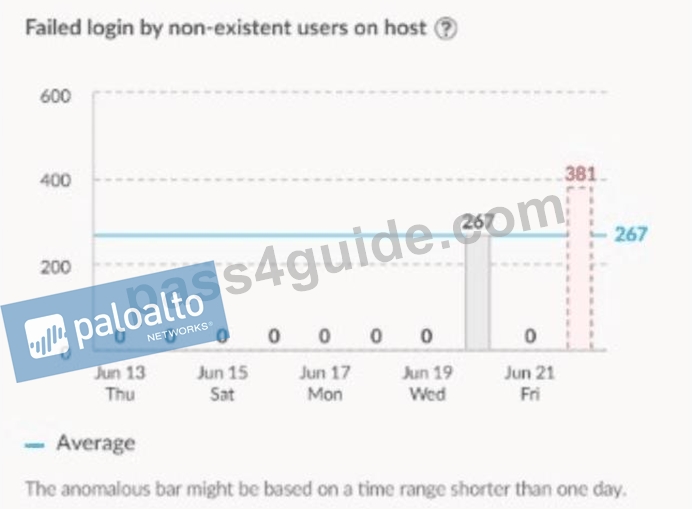
- A. Baseline
- B. Anomaly
- C. Contextual
- D. Behavioral
Answer: B
Explanation:
Comprehensive and Detailed Explanation From Exact Extract:
The correct answer isD - Anomaly.
In Cortex XSIAM,Anomaly analyticsare designed to trigger alerts when a monitored activity deviates significantly from the established baseline or historical average. In the image, the "Failed login by non- existent users on host" metric remains at zero for several days and then suddenly spikes to 267 and 381-far above the average threshold. This significant deviation from the established norm is identified by the analytics engine as ananomalyand will trigger an alert for further investigation.
"Anomaly analytics identify significant deviations from established baselines or averages, such as unusual spikes in failed login attempts or other behavioral outliers, and trigger alerts for potential threats." Document Reference:XSIAM Analyst ILT Lab Guide.pdf Page:Page 28 (Alerting and Detection section)
NEW QUESTION # 79
What is the primary difference between a BIOC and a correlation rule in Cortex XSIAM?
Response:
- A. Correlation rules generate raw data only
- B. BIOCs are signature-based; correlation rules are behavior-based
- C. BIOCs are customizable; correlation rules are fixed
- D. Correlation rules detect behavior patterns; BIOCs identify raw log anomalies
Answer: D
NEW QUESTION # 80
Which two actions can an analyst take to reduce the number of false positive alerts generated by a custom BIOC? (Choose two.)
- A. Implement an alert exclusion rule.
- B. Implement a BIOC rule exception
- C. Implement a shunt in a BIOC bypass rule
- D. Implement a global exception in the prevention profile.
Answer: A,B
Explanation:
The correct answers areC (Implement an alert exclusion rule)andD (Implement a BIOC rule exception).
* Alert exclusion rule:Allows analysts to specify criteria under which certain alerts are excluded from being generated, reducing unnecessary noise.
* BIOC rule exception:Enables the analyst to exempt specific cases or environments from triggering a BIOC, effectively minimizing false positives.
"False positives from BIOC rules can be minimized by implementing alert exclusion rules or setting BIOC rule exceptions for known benign activity." Document Reference:XSIAM Analyst ILT Lab Guide.pdf Page:Page 58 (Alerting and Detection section)
NEW QUESTION # 81
You are reviewing a playbook where task execution fails when a required indicator is missing. Which features help ensure playbook reliability in such cases?
(Choose two)
Response:
- A. Dynamic incident tagging
- B. Hard-coded credentials
- C. Error handling conditions
- D. Built-in retry logic
Answer: C,D
NEW QUESTION # 82
Which feature enables incident responders to directly respond from within Cortex XSIAM?
Response:
- A. Native response actions
- B. Asset Inventory Map
- C. XQL Replay
- D. Endpoint Profile Manager
Answer: A
NEW QUESTION # 83
Which type of alert in Cortex XSIAM is primarily based on endpoint telemetry and behavior?
Response:
- A. BIOC
- B. IOC
- C. XDR Agent
- D. Correlation
Answer: A
NEW QUESTION # 84
In the Identity Threat Detection and Response (ITDR) module, what does "compromised identity" typically indicate?
Response:
- A. USB device connection
- B. Missing antivirus signature
- C. Unauthorized access or behavior from a known identity
- D. Failed software update
Answer: C
NEW QUESTION # 85
An alert involves credential dumping. Reviewing the causality chain, you notice the following:
- lsass.exe is accessed by powershell.exe
- Prior to this, cmd.exe launched the PowerShell script
What can you infer?
Response:
- A. It's a known benign service activity
- B. Possible credential access tactic
- C. There is an indicator of defense evasion
- D. Scripted behavior likely launched manually
Answer: B,C
NEW QUESTION # 86
You notice multiple endpoints reporting offline in XSIAM. Which actions would help confirm their operational status?
Response:
- A. Review recent heartbeat logs
- B. Ping the endpoint from the agent
- C. Check agent connection timestamps
- D. Perform a live terminal scan
Answer: A,C
NEW QUESTION # 87
SCENARIO:
A security analyst has been assigned a ticket from the help desk stating that users are experiencing errors when attempting to open files on a specific network share. These errors state that the file format cannot be opened. IT has verified that the file server is online and functioning, but that all files have unusual extensions attached to them.
The security analyst reviews alerts within Cortex XSIAM and identifies malicious activity related to a possible ransomware attack on the file server. This incident is then escalated to the incident response team for further investigation.
Upon reviewing the incident, the responders confirm that ransomware was successfully executed on the file server. Other details of the attack are noted below:
* An unpatched vulnerability on an externally facing web server was exploited for initial access
* The attackers successfully used Mimikatz to dump sensitive credentials that were used for privilege escalation
* PowerShell was used on a Windows server for additional discovery, as well as lateral movement to other systems
* The attackers executed SystemBC RAT on multiple systems to maintain remote access
* Ransomware payload was downloaded on the file server via an external site "file io" QUESTION STATEMENT:
Which hunt collection category in Cortex XSIAM should the incident responders use to identify all systems where the attackers established persistence during the attack?
- A. Network Data
- B. Remote Access
- C. Command History
- D. Process Execution
Answer: B
Explanation:
The correct answer isA - Remote Access.
TheRemote Accesshunt collection category in Cortex XSIAM is specifically designed to help incident responders identify endpoints where attackers have installed remote access tools (RATs) or backdoors, which are classic methods of attacker persistence. In this scenario, the attackers executedSystemBC RATon multiple systems to maintain remote access, making the "Remote Access" category the most relevant for finding all endpoints where persistence was established.
"Remote Access hunt collections in Cortex XSIAM identify the presence of remote access tools such as RATs and backdoors used by attackers to maintain persistence on endpoints. Analysts should review this collection category after incidents involving tools like SystemBC RAT." Document Reference:XSIAM Analyst ILT Lab Guide.pdf, Page 28 (Alerting and Detection / Threat Intel Management sections)
NEW QUESTION # 88
What is the role of the XQL Helper in Cortex XSIAM?
Response:
- A. Offers syntax assistance and autocomplete for queries
- B. Manages incident triage
- C. Provides real-time script testing
- D. Stores alert configurations
Answer: A
NEW QUESTION # 89
You're investigating a compromised device and want to perform remote forensics. Which live terminal options would be effective?
(Choose two)
Response:
- A. Retrieve registry hives
- B. Enable USB ports
- C. Run endpoint file retrieval
- D. Deactivate local firewall
Answer: A,C
NEW QUESTION # 90
What can incident context data reveal to the analyst?
Response:
- A. Investigation policies
- B. The software license status
- C. Related users, endpoints, and alerts
- D. Compliance score
Answer: C
NEW QUESTION # 91
An asset is flagged in ASM for hosting an exposed RDP port. What steps might follow?
(Choose two)
Response:
- A. Trigger endpoint isolation
- B. Delete the asset from inventory
- C. Review asset owner and apply patches
- D. Assess for rule revalidation
Answer: C,D
NEW QUESTION # 92
A Cortex XSIAM analyst is investigating a security incident involving a workstation after having deployed a Cortex XDR agent for 45 days. The incident details include the Cortex XDR Analytics Alert "Uncommon remote scheduled task creation." Which response will mitigate the threat?
- A. Allow list the processes to reduce alert noise.
- B. Initiate the endpoint isolate action to contain the threat.
- C. Prioritize blocking the source IP address to prevent further login attempts.
- D. Revoke user access and conduct a user audit
Answer: B
Explanation:
The correct answer isA - Initiate the endpoint isolate action to contain the threat.
For incidents indicating possible remote compromise or unauthorized task creation, the most effective initial response isendpoint isolation. This cuts off the endpoint's network access, preventing lateral movement and limiting attacker activity until further investigation and remediation.
"The endpoint isolate action is the primary containment step in incidents involving suspected remote compromise, halting network communication to reduce further risk." Document Reference:XSIAM Analyst ILT Lab Guide.pdf Page:Page 40 (Incident Handling/SOC section)
NEW QUESTION # 93
While investigating an IOC, you want to validate its presence in the environment. What steps should you take?
(Choose two)
Response:
- A. Use the XQL query builder
- B. Run threat intel reputation scan
- C. Check the endpoint inventory
- D. Search the IOC in the Cortex dataset
Answer: A,D
NEW QUESTION # 94
What is the core purpose of attack surface rules?
Response:
- A. To detect and classify exposed services or CVEs
- B. To apply endpoint policy configurations
- C. To define user access roles
- D. To monitor email phishing attacks
Answer: A
NEW QUESTION # 95
What is the causality chain used for in Cortex XSIAM investigations?
Response:
- A. Exporting reports for compliance
- B. Identifying license usage
- C. Visualizing process relationships and execution flow
- D. Mapping users to devices
Answer: C
NEW QUESTION # 96
An alert triggered by the XDR Agent includes registry changes, suspicious child processes, and script execution. What source types and logic apply here?
(Choose two)
Response:
- A. BIOC behavioral logic
- B. Correlation rule chaining
- C. IOC match logic
- D. Endpoint telemetry collection
Answer: A,D
NEW QUESTION # 97
Match each alert evidence type with its investigation value:
Alert Evidence
A) Timeline
B) ITDR Findings
C) Causality Chain
D) File Hash
Use in Investigation
1. Tracks sequence of events
2. Indicates identity misuse
3. Shows parent-child process lineage
4. Maps to known malware indicators
Response:
- A. A-1, B-2, C-4, D-3
- B. A-1, B-2, C-3, D-4
- C. A-1, B-3, C-2, D-4
- D. A-4, B-2, C-3, D-1
Answer: B
NEW QUESTION # 98
......
REAL XSIAM-Analyst Exam Questions With 100% Refund Guarantee : https://www.pass4guide.com/XSIAM-Analyst-exam-guide-torrent.html
Practice with XSIAM-Analyst Dumps for Security Operations Certified Exam Questions & Answer: https://drive.google.com/open?id=15ng6XF7aXTZf33O_sGMVcpj1NBkmAgJW