


2024 100% Free AZ-700 Daily Practice Exam With 244 Questions
AZ-700 exam torrent Microsoft study guide
NEW QUESTION # 125
You have the Azure App Service app shown in the App Service exhibit.
The VNet Integration settings for as12 are configured as shown in the Vnet Integration exhibit.
The Private Endpoint connections settings for as12 are configured as shown in the Private Endpoint connections exhibit.
For each of the following statements, select Yes if the statement is true. Otherwise, select No.
NOTE: Each correct selection is worth one point.
Answer:
Explanation:
NEW QUESTION # 126
Task 10
You need to configure VNET1 to log all events and metrics. The solution must ensure that you can query the events and metrics directly from the Azure portal by using KQL.
Answer:
Explanation:
See the Explanation below for step by step instructions.
Explanation
Here are the steps and explanations for configuring VNET1 to log all events and metrics and query them by using KQL:
* To enable logging for VNET1, you need to create a diagnostic setting that collects the platform metrics and logs from the virtual network and routes them to one or more destinations. You can choose to send the data to a Log Analytics workspace, a storage account, an event hub, or a partner solution1.
* To create a diagnostic setting, you need to go to the Azure portal and select your virtual network. Then select Diagnostic settings under Monitoring and select + Add diagnostic setting1.
* On the Add diagnostic setting page, enter or select the following information:
* Diagnostic setting name: Type a unique name for your diagnostic setting.
* Destination details: Select the destination where you want to send the data. For example, you can select Send to Log Analytics workspace and choose your workspace from the list.
* Log: Select the categories of logs that you want to collect. For VNET1, you can select NetworkSecurityGroupEvent and NetworkSecurityGroupRuleCounter as the log categories2.
* Metric: Select AllMetrics to collect all the platform metrics for VNET12.
* Select Save to create your diagnostic setting1.
* To query the events and metrics from the Azure portal by using KQL, you need to go to the Log Analytics workspace that you selected as the destination. Then select Logs under General and enter your KQL query in the query editor3.
* For example, you can use the following KQL query to get the top 10 network security group events for VNET1 in the last 24 hours:
NetworkSecurityGroupEvent
| where TimeGenerated > ago(24h)
| where ResourceId contains "VNET1"
| summarize count() by EventID
| top 10 by count_
Copy
* Select Run to execute your query and view the results in a table or a chart3.
NEW QUESTION # 127
You have an on-premises network.
You have an Azure subscription that contains a virtual network named VNet1. VNet1 is connected to an Azure Virtual WAN hub named Hub1.
You need to enable connectivity between the on-premises network and VNet1 by using Hub1.
Which three actions should you perform in sequence? To answer, move the appropriate actions from the list of actions to the answer area and arrange them in the correct order.
Answer:
Explanation:
Explanation:
NEW QUESTION # 128
You have the network security groups (NSGs) shown in the following table.
In NSG1, you create inbound rules as shown in the following table.
You have the Azure virtual machines shown in the following table.
NSG2 has only the default rules configured.
For each of the following statements, select Yes if the statement is true. Otherwise, select No.
NOTE: Each correct selection is worth one point.
Answer:
Explanation:
NEW QUESTION # 129
You have an Azure Traffic Manager parent profile named TM1. TM1 has two child profiles named TM2 and TM3.
TM1 uses the performance traffic-routing method and has the endpoints shown in the following table.
TM2 uses the weighted traffic-routing method with MinChildEndpoint = 2 and has the endpoints shown in the following table.
TM3 uses priority traffic-routing method and has the endpoints shown in the following table.
The App2, App4, and App6 endpoints have a degraded monitoring status.
To which endpoint is traffic directed? To answer, select the appropriate options in the answer area.
NOTE: Each correct selection is worth one point
Answer:
Explanation:
Explanation
Diagram Description automatically generated
Reference:
https://docs.microsoft.com/en-us/azure/traffic-manager/traffic-manager-nested-profiles Traffic from West Europe:
Basedd on TM1 table, West Europe will trigger TM2. However, as the MinChildEndpoint is set to 2, and App4 is degraded (down), the entire TM2 will not be considered available.
This goes back to the origin TM1 that uses performance traffic-routing method, which means the closest location is App1 and naturally be the next best performance instance.
Hence, Answer = App1
Traffic from West US:
Based on TM1 table, West US will trigger TM3. However, both App2 and App6 were degraded (down), so none of them can be considered.
This goes back to the original TM1 that uses performance traffic-routing method, from TM1, the other 2 US locations would be App2 and App3. But App2 we know it's already degraded (unavailable), hence the only option would be App3.
Answer = App3
NEW QUESTION # 130
You need to connect an on-premises network and art Azure environment. The solution must use ExpressRoute and support failing over to a Site-to Site VPN connection if there is an ExpressRoute failure.
What should you configure? To answer, select the appropriate options in the answer area.
NOTE: Each correct selection is worth one point.
Answer:
Explanation:
NEW QUESTION # 131
Your company has five offices. Each office has a firewall device and a local internet connection. The offices connect to a third-party SD-WAN.
You have an Azure subscription that contains a virtual network named Vnet1. Vnet1 contains a virtual network gateway named Gateway1. Each office connects to Gateway1 by using a Site-to-Site VPN connection.
You need to replace the third-party SD-WAN with an Azure Virtual WAN. What should you include in the solution?
- A. Enable active-active mode on Gateway1.
- B. Create new Point-to-Site (P2S) VPN connections on the firewall devices.
- C. Delete Gateway1.
- D. Create an Azure Traffic Manager profile.
Answer: B
NEW QUESTION # 132
You have an Azure subscription that contains a virtual network gateway named VNetGwy1. VNetGwy1 has a public IP address of 20.25.32.214.
You need to query the health probe of VNetGwy1,
How should you complete the URI? To answer, select the appropriate options in the answer area.
NOTE: Each correct selection is worth one point.
Answer:
Explanation:
Explanation:
NEW QUESTION # 133
You are implementing the Virtual network requirements for Vnet6.
What is the minimum number of subnets and service endpoints you should create? To answer, select the appropriate options in the answer area.
NOTE: Each correct selection is worth one point.
- A. 2,4
Answer: A
NEW QUESTION # 134
Your company, named Contoso, Ltd, has an Azure subscription that contains the resources show in the following table.
You plan to deploy Azure Front Door. The solution must meet the following requirement:
* Requests to a URL of https://contoso.azurefd.net/uk must be routed to App1uk.
* Requests to a URL of https://contoso.azurefd.net/us must be routed to App1us.
* Requests to a URL of https://contoso.azurefd.net/images must be routed to the storage account closest to the user.
What is the minimum number of backend pools and routing rules you should create? To answer, the appropriate number to the correct component. Each number may be used once, more than once, or not at all.
You may need to drag the spilt bar between panes scroll to view content:
Note: Each correct selection is worth one point.
Answer:
Explanation:
Explanation
NEW QUESTION # 135
You have an Azure Front Door instance named FrontDoor1.
You deploy two instances of an Azure web app to different Azure regions.
You plan to provide access to the web app through FrontDoor1 by using the name app1.contoso.com.
You need to ensure that FrontDoor1 is the entry point for requests that use app1.contoso.com.
Which three actions should you perform in sequence? To answer, move the appropriate actions from the list of actions to the answer area and arrange them in the correct order.
Answer:
Explanation:
Explanation
Table Description automatically generated
NEW QUESTION # 136
SIMULATION
Task 5
You need to ensure that requests for wwwjelecloud.com from any of your Azure virtual networks resolve to frontdoor1.azurefd.net.
Answer:
Explanation:
See the Explanation below for step by step instructions
Explanation:
Here are the steps and explanations for ensuring that requests for wwwjelecloud.com from any of your Azure virtual networks resolve to frontdoor1.azurefd.net:
To use a custom domain with your Azure Front Door, you need to create a CNAME record with your domain provider that points to the Front Door default frontend host. A CNAME record is a type of DNS record that maps a source domain name to a destination domain name1.
To create a CNAME record, you need to sign in to your domain registrar's website and go to the page for managing DNS settings1.
Create a CNAME record with the following information1:
Source domain name: wwwjelecloud.com
Destination domain name: frontdoor1.azurefd.net
Save your changes and wait for the DNS propagation to take effect1.
To verify the custom domain, you need to go to the Azure portal and select your Front Door profile. Then select Domains under Settings and select Add2.
On the Add a domain page, select Non-Azure validated domain as the Domain type and enter wwwjelecloud.com as the Domain name. Then select Add2.
On the Domains page, select wwwjelecloud.com and select Verify. This will check if the CNAME record is correctly configured2.
Once the domain is verified, you can associate it with your Front Door endpoint. On the Domains page, select wwwjelecloud.com and select Associate endpoint. Then select your Front Door endpoint from the drop-down list and select Associate2.
NEW QUESTION # 137
You have the Azure environment shown In the Azure Environment exhibit. (Click the Azure Environment tab.) The settings for each subnet are shown in the following table.
The Firewalls and virtual networks settings for storage1 are configured as shown in the Storage1 exhibit. (Click the Storage1 tab.) For each of the following statements, select Yes if the statement is true. Otherwise, select No. NOTE: Each correct selection is worth one point.
Answer:
Explanation:
NEW QUESTION # 138
You have an Azure subscription that contains multiple virtual machines in the West US Azure region.
You need to use Traffic Analytics.
Which two resources should you create? Each correct answer presents part of the solution. (Choose two.)
NOTE: Each correct answer selection is worth one point.
- A. an Azure Monitor workbook
- B. a storage account
- C. an Azure Sentinel workspace
- D. an Azure Monitor data collection rule
- E. a Log Analytics workspace
Answer: B,E
Explanation:
Reference:
https://docs.microsoft.com/en-us/azure/network-watcher/traffic-analytics
A storage acccount is used to store network security group flow logs.
A Log Analytics workspace is used by Traffic Analytics to store the aggregated and indexed data that is then used to generate the analytics.
https://docs.microsoft.com/en-us/azure/network-watcher/traffic-analytics#enable-flow-log-settings
NEW QUESTION # 139
You need to implement a P2S VPN for the users in the branch office. The solution must meet the hybrid networking requirements.
What should you do? To answer, select the appropriate options in the answer area.
NOTE: Each correct selection is worth one point.
Answer:
Explanation:
NEW QUESTION # 140
You have an Azure subscription that contains the resources shown in the following table.
You plan to deploy an app named App1 to meet the following requirements.
* External users must be able to access App1 from the internet.
* App1 will be load balanced across all the virtual machines.
* App1 will be hosted on VM1, VM2. VM3. and VM4.
* App1 must be available if an Azure region fails.
* Costs must be minimized.
You need to implement a global load balancer solution for App.
What should you configure? To answer, select the appropriate options in the answer area NOTE: Bach correct answer is worth one point.
Answer:
Explanation:
Explanation:
NEW QUESTION # 141
You need to implement name resolution for the cloud.liwareinc.com. The solution must meet the networking requirements.
What should you do? To answer, select the appropriate options in the answer area.
NOTE: Each correct selection is worth one point.
Answer:
Explanation:
Reference:
https://docs.microsoft.com/en-us/azure/dns/private-dns-autoregistration
https://docs.microsoft.com/en-us/azure/virtual-network/virtual-networks-name-resolution-for-vms-and-role-instances
NEW QUESTION # 142
You need to implement a P2S VPN for the users in the branch office. The solution must meet the hybrid networking requirements.
What should you do? To answer, select the appropriate options in the answer area.
NOTE: Each correct selection is worth one point.
Answer:
Explanation:
NEW QUESTION # 143
You have two on-premises datacenters.
You have an Azure subscription that contains four virtual networks named VNet1 VNet2, VNet3, and VNet4 You create an Azure virtual WAN named VWAN1. VWAN1 contains a single virtual hub that is connected to both on-premises datacenters and all the virtual networks in a full mesh topology.
You create a route table named RT1.
You need to configure VWAN1 to meet the following requirements:
* Connectivity between VNet1 and VNet2 and both on-premises datacenters must be allowed.
* Connectivity between VNet3 and VNet4 and both on-premises datacenters must be allowed.
* VNet1 and VNet2 must be isolated from VNet3 and VNet4.
How should you configure routing for VNet1 and VNet2 and for both on-premises datacenters? To answer, drag the appropriate route tables and route table propagation to the correct requirements. Each route table and route table propagation may be used once, more than once, or not at all. You may need to drag the split bar between panes or scroll to view content.
NOTE: Each correct selection is worth one point.
Answer:
Explanation:
NEW QUESTION # 144
You plan to deploy Azure Virtual WAN.
You need to deploy a virtual WAN hub that meets the following requirements:
Supports 10 sites that will connect to the virtual WAN hub by using a Site-to-Site VPN connection Supports 8 Gbps of ExpressRoute traffic Minimizes costs What should you configure? To answer, select the appropriate options in the answer area.
NOTE: Each correct selection is worth one point.
Answer:
Explanation:
Explanation
Graphical user interface, diagram Description automatically generated with medium confidence
Reference:
https://docs.microsoft.com/en-us/azure/virtual-wan/virtual-wan-about
NEW QUESTION # 145
You have an Azure subscription that contains two virtual networks named Vnet1 and Vnet2.
You register a public DNS zone named fabrikam.com. The zone is configured as shown in the Public DNS Zone exhibit.
You have a private DNS zone named fabrikam.com. The zone is configured as shown in the Private DNS Zone exhibit.
You have a virtual network link configured as shown in the Virtual Network Link exhibit.
For each of the following statements, select Yes if the statement is true. Otherwise, select No.
NOTE: Each correct selection is worth one point.
Answer:
Explanation:
Explanation:
Box 1: Yes
DNS queries from the internet use the public DNS zone. In the public DNS zone, www.fabrikam.com is a CNAME record that resolves to appservice1.fabrikam.com which resolves to 131.107.1.1.
Box 2: No
DNS queries from the internet use the public DNS zone. There is no DNS record for server1.fabrikam.com in the public DNS zone.
Box 3: No
The private DNS zone is linked to VNet1, not VNet2. Therefore, resources in VNet2 cannot query the private DNS zone.
NEW QUESTION # 146
You have an Azure Front Door instance named FrontDoor1.
You deploy two instances of an Azure web app to different Azure regions.
You plan to provide access to the web app through FrontDoor1 by using the name app1.contoso.com.
You need to ensure that FrontDoor1 is the entry point for requests that use app1.contoso.com.
Which three actions should you perform in sequence? To answer, move the appropriate actions from the list of actions to the answer area and arrange them in the correct order.
Answer:
Explanation:
Explanation
Table Description automatically generated
NEW QUESTION # 147
You have two Azure subscriptions named Subscription1 and Subscription2.
There are no connections between the virtual networks in two subscriptions.
You configure a private link service as shown in the privatelinkservice1 exhibit. (Click the privatelinkservice1 tab.)
You create a load balancer name in Subscription1 and configure the backend pool shown in the lb1 exhibit. (Click tie 1b1 tab.)
You create a private endpoint in Subscription2 as shown in the privateendpoint4 exhibit. (Click the privateendpoint4)
For each of the following statements, select YES if the statement is true. Otherwise. select No.
Answer:
Explanation: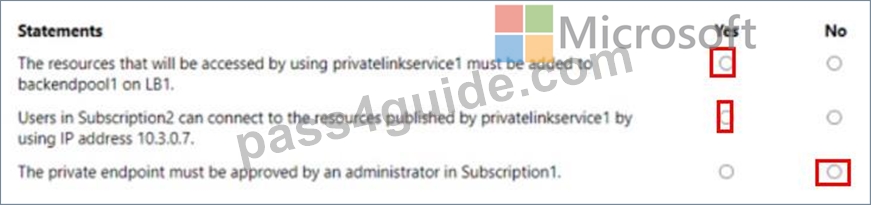
NEW QUESTION # 148
Note: This question is part of a series of questions that present the same scenario. Each question in the series contains a unique solution that might meet the stated goals. Some question sets might have more than one correct solution, while others might not have a correct solution.
After you answer a question in this section, you will NOT be able to return to it. As a result, these questions will not appear in the review screen.
You have an Azure application gateway that has Azure Web Application Firewall (WAF) enabled.
You configure the application gateway to direct traffic to the URL of the application gateway.
You attempt to access the URL and receive an HTTP 403 error. You view the diagnostics log and discover the following error.
You need to ensure that the URL is accessible through the application gateway.
Solution: You add a rewrite rule for the host header.
Does this meet the goal?
- A. No
- B. Yes
Answer: A
Explanation:
Explanation
https://docs.microsoft.com/en-us/azure/application-gateway/rewrite-http-headers-url#limitations
NEW QUESTION # 149
You have an Azure virtual network named Vnet1 that contains two subnets named Subnet1 and Subnet2.
You have the NAT gateway shown in the NATgateway1 exhibit.
You have the virtual machine shown in the VM1 exhibit.
Subnet1 is configured as shown in the Subnet1 exhibit.
For each of the following statements, select Yes of the statement is true. Otherwise, select No.
NOTE: Each correct selection is worth one point.
Answer:
Explanation:
Reference:
https://docs.microsoft.com/en-us/azure/virtual-network/nat-gateway/nat-gateway-resource
NEW QUESTION # 150
......
Use Valid New AZ-700 Test Notes & AZ-700 Valid Exam Guide: https://www.pass4guide.com/AZ-700-exam-guide-torrent.html
AZ-700 Actual Questions Answers PDF 100% Cover Real Exam Questions: https://drive.google.com/open?id=1HV5xNQ7H6bQLYlNGMPTUe0nywvxjsZNh