


[Jan-2022] 1Z0-1072-20 Certification with Actual Questions from Pass4guide
Updated 1Z0-1072-20 Dumps PDF - 1Z0-1072-20 Real Valid Brain Dumps With 240 Questions!
Oracle 1Z0-1072-20 Exam Syllabus Topics:
| Topic | Details |
|---|---|
| Topic 1 |
|
| Topic 2 |
|
| Topic 3 |
|
| Topic 4 |
|
| Topic 5 |
|
| Topic 6 |
|
| Topic 7 |
|
| Topic 8 |
|
NEW QUESTION 137
You are tasked with creating a highly available clustered application on Oracle Cloud Infrastructure consisting of three nodes. The round-trip latency between nodes must be less than 500 µs (micro-seconds) and your cluster should be resilient to hardware failure.
What is the recommended deployment strategy?
- A. Deploy the cluster nodes in a single region and deploy each node in different fault domains within a single AD.
- B. Deploy the cluster nodes in a single region and deploy each node into a different AD. Select the same fault domain in each AD to ensure consistency.
- C. Deploy the cluster nodes in a single region and deploy each node into a different AD.
- D. Deploy the cluster nodes in two separate regions and take advantage of multiple availability domains (ADs) in each region.
Answer: A
NEW QUESTION 138
A customer has launched a compute Instance in the Virtual Cloud Network (VCN), which has an Internet gateway, a service gateway, a default security lists and a default route table. Customer has opened up Port 22 in the security lists attached to the compute instance subnet, however is still unable to connect to compute instances using ssh.
Which option would remedy this situation?
- A. Modify the route table associated with the VCN subnet in which the instance resides. Add a following route to the route table.
Destination CIDR: 0.0.0.0/0
Target: Dynamic Routing Gateway (DRG) - B. Modify the route table associated with the VCN subnet in which the instance resides. Add a following route to the route table.
Destination CIDR: 0.0.0.0/0
Target: Internet Gateway (IGW) - C. Modify the security list associated with the VCN subnet in which the instance resides. Add a stateful egress rule to allow icmp traffic in addition to the port 22.
- D. Modify the route table associated with the VCN subnet in which the instance resides. Add a following route to the route table.
Destination CIDR: 0.0.0.0/0
Target: Service Gateway (SGW)
Answer: B
Explanation:
Explanation
You create an internet gateway in the context of a specific VCN. In other words, the internet gateway is automatically attached to a VCN. However, you can disable and re-enable the internet gateway at any time.
For traffic to flow between a subnet and an internet gateway, you must create a route rule accordingly in the subnet's route table (for example, destination CIDR = 0.0.0.0/0 and target = internet gateway). If the internet gateway is disabled, that means no traffic will flow to or from the internet even if there's a route rule that enables that traffic.
For the purposes of access control, you must specify the compartment where you want the internet gateway to reside. If you're not sure which compartment to use, put the internet gateway in the same compartment as the cloud network.
NEW QUESTION 139
You have created a virtual cloud network (VCN) with three private subnets. Two of the subnets contain application servers and the third subnet contains a DB System. The application requires a shared file system so you have provisioned one using the file storage service (FSS). You also created the corresponding mount target in one of the application subnets. The VCN security lists are properly configured so that both application servers and the DB System can access the file system. The security team determines that the DB System should have read-only access to the file system.
What change would you make to satisfy this requirement?
- A. Connect via SSH to one of the application servers where the file system has been mounted. Use the Unix command chmod to change permissions on the file system directory, allowing the database user read only access.
- B. Create an NFS export option that allows READ_ONLY access where the source is the CIDR range of the DB System subnet.
- C. Create an instance principal for the DB System. Write an Identity and Access Management (IAM) policy that allows the instance principal read-only access to the file storage service.
- D. Modify the security list associated with the subnet where the mount target resides. Change the ingress rules corresponding to the DB System subnet to be stateless.
Answer: B
Explanation:
Explanation
NFS export options enable you to create more granular access control than is possible using just security list rules to limit VCN access. You can use NFS export options to specify access levels for IP addresses or CIDR blocks connecting to file systems through exports in a mount target.
NEW QUESTION 140
In which two ways does Oracle Cloud Infrastructure (OCI) file storage (FSS) differ from OCI object storage and block volume services? (Choose two.)
- A. Block volume service is NVMe based, while FSS is not
- B. A file system is created within an availability domain, whereas object storage buckets exist at the region level
- C. FSS uses the network file system (NFS) protocol, whereas block volume uses iSCSI
- D. Object storage and block volume services offer default encryption, but FSS does not
Answer: B,C
NEW QUESTION 141
When terminating a compute instance, which statement is true?
- A. Users can preserve the boot volume associated with the instance.
- B. The instance needs to be stopped first, and then terminated.
- C. All block volumes attached to the instance are terminated.
- D. The boot volume is always deleted.
Answer: A
Explanation:
Explanation
You can permanently terminate (delete) instances that you no longer need. Any attached VNICs and volumes are automatically detached when the instance terminates. Eventually, the instance's public and private IP addresses are released and become available for other instances. By default, the instance's boot volume is deleted when you terminate the instance, however you can preserve the boot volume associated with the instance, so that you can attach it to a different instance as a data volume, or use it to launch a new instance.
NEW QUESTION 142
Given: When creating multiple subnets within a Virtual Cloud Network (VCN), security lists are often made to group common services, for example, SSH and RDP (remote access), 80 and 443 (HTTP), and so on.
By default, what is the maximum number of security lists that can be associated with a subnet upon creation?
- A. 0
- B. 1
- C. 2
- D. 3
Answer: A
NEW QUESTION 143
You have two NFS clients running in two different subnets within the same Oracle Cloud Infrastructure (OCI) Virtual Cloud Network (VCN). You have created a shared file system for the two NFS clients who want to connect to the same file system, but you want to restrict one of the clients to have READ access while the other has READ/Write access. Which OCr feature would you leverage to meet this requirement?
- A. Use VCN security rules to control access for the NFS clients
- B. Use File Storage NFS Export Options to control access for the NFS clients
- C. Use OCI Identity Access Management to control access for the NFS clients
- D. Use NFS security to control access for the NES clients
Answer: B
Explanation:
Explanation
Oracle Cloud Infrastructure File Storage service provides a durable, scalable, secure, enterprise-grade network file system. You can connect to a File Storage service file system from any bare metal, virtual machine, or container instance in your Virtual Cloud Network (VCN). You can also access a file system from outside the VCN using Oracle Cloud Infrastructure FastConnect and Internet Protocol security (IPSec) virtual private network (VPN).
EXPORT
Exports control how NFS clients access file systems when they connect to a mount target. File systems are exported (made available) through mount targets. Each mount target maintains an export set which contains one or many exports. A file system must have at least one export in one mount target in order for instances to mount the file system. The information used by an export includes the file system OCID, mount target OCID, export set OCID, export path, and client export options. For more information, see Managing Mount Targets.
EXPORT SET
Collection of one or more exports that control what file systems the mount target exports using NFSv3 protocol and how those file systems are found using the NFS mount protocol. Each mount target has an export set. Each file system associated with the mount target has at least one export in the export set.
EXPORT PATH
A path that is specified when an export is created. It uniquely identifies the file system within the mount target, letting you associate up to 100 file systems to a single mount target. This path is unrelated to any path within the file system itself, or the client mount point path.
EXPORT OPTIONS
NFS export options are a set of parameters within the export that specify the level of access granted to NFS clients when they connect to a mount target. An NFS export options entry within an export defines access for a single IP address or CIDR block range. For more information, see Working with NFS Export Options.
NEW QUESTION 144
Which statement Is true about Data Guard implementation in Oracle Cloud Infrastructure (OCI) bare metal and virtual machine database systems?
- A. Both database systems must be in the same compartment.
- B. Database systems need not be the same shape type (e.g, primary database can be a virtual machine, and standby database a bare metal shape, and vice versa).
- C. Primary and standby database versions and editions need not be Identical.
- D. Primary and standby databases must be in the same OCI region.
Answer: A
Explanation:
Reference:
https://docs.cloud.oracle.com/en-us/iaas/Content/Database/Tasks/exausingdataguard.htm
NEW QUESTION 145
Which two statements are true about an Oracle Cloud Infrastructure object storage bucket? (Choose two.)
- A. You cannot change a bucket from private to public after it is created
- B. You cannot edit or append data to an object, but you can replace the entire object
- C. You can associate a bucket with multiple compartments
- D. You can associate a bucket with only a single compartment
Answer: B,D
Explanation:
A bucket is associated with a single compartment.
You can't edit or append data to an object, but you can replace the entire object.
NEW QUESTION 146
You are a system administrator of your company and you are asked to manage updates and patches across all your compute instances running Oracle Linux in Oracle Cloud Infrastructure (OCI). As part of your task, you need to apply all the latest kernel security updates to all instances.
Which OCI service will allow you to complete this task?
- A. Resource Manager
- B. Storage Gateway
- C. Registry
- D. OS Management
- E. Streaming
Answer: D
Explanation:
Reference:
https://blogs.oracle.com/cloud-infrastructure/os-management-with-oracle-cloud-infrastructure
NEW QUESTION 147
Which two statements are true about Oracle Cloud Infrastructure IPSec VPN Connect?
- A. OCI IPSec VPN can be configured in trans port mode only
- B. OCI IPSec VPN tunnel supports only static routes to route traffic
- C. OCI IPSec VPN can be configured in tunnel mode only
- D. Each OCI IPSec VPN consists of multiple redundant IPSec tunnels
Answer: C,D
Explanation:
Explanation
VPN Connect provides a site-to-site IPSec VPN between your on-premises network and your virtual cloud network (VCN). The IPSec protocol suite encrypts IP traffic before the packets are transferred from the source to the destination and decrypts the traffic when it arrives.
On general, IPSec can be configured in the following modes:
Transport mode: IPSec encrypts and authenticates only the actual payload of the packet, and the header information stays intact.
Tunnel mode (supported by Oracle): IPSec encrypts and authenticates the entire packet. After encryption, the packet is then encapsulated to form a new IP packet that has different header information.
Oracle Cloud Infrastructure supports only the tunnel mode for IPSec VPNs.
Each Oracle IPSec VPN consists of multiple redundant IPSec tunnels. For a given tunnel, you can use either Border Gateway Protocol (BGP) dynamic routing or static routing to route that tunnel's traffic. More details about routing follow.
IPSec VPN site-to-site tunnels offer the following advantages:
Public internet lines are used to transmit data, so dedicated, expensive lease lines from one site to another aren't necessary.
The internal IP addresses of the participating networks and nodes are hidden from external users.
The entire communication between the source and destination sites is encrypted, significantly lowering the chances of information theft.
NEW QUESTION 148
You are designing a lab exercise for your team that has a large number of graphics with large file sizes. The application becomes unresponsive if the graphics are embedded in the application. You have uploaded the graphics to Oracle Cloud Infrastructure and only added the URL in the application. You need to ensure these graphics are accessible without requiring any authentication for an extended period of time.
How can you achieve these requirements?
- A. Make the object storage bucket private and all objects public and use the URL found in the Object "Details".
- B. Create pre-authenticated requests (PAR) and specify 00:00:0000 as the expiration time.
- C. Create PARs and do not specify an expiration date.
- D. Make the object storage bucket public and use the URL found in the Object "Details".
Answer: D
Explanation:
Pre-authenticated requests provide a way to let you access a bucket or an object without having your own credentials. For example, you can create a request that lets you upload backups to a bucket without owning API keys.
When you create a bucket, the bucket is considered a private bucket and the access to the bucket and bucket contents requires authentication and authorization. However, Object Storage supports anonymous, unauthenticated access to a bucket. You make a bucket public by enabling read access to the bucket.
pre-authenticated requests have to select expiration date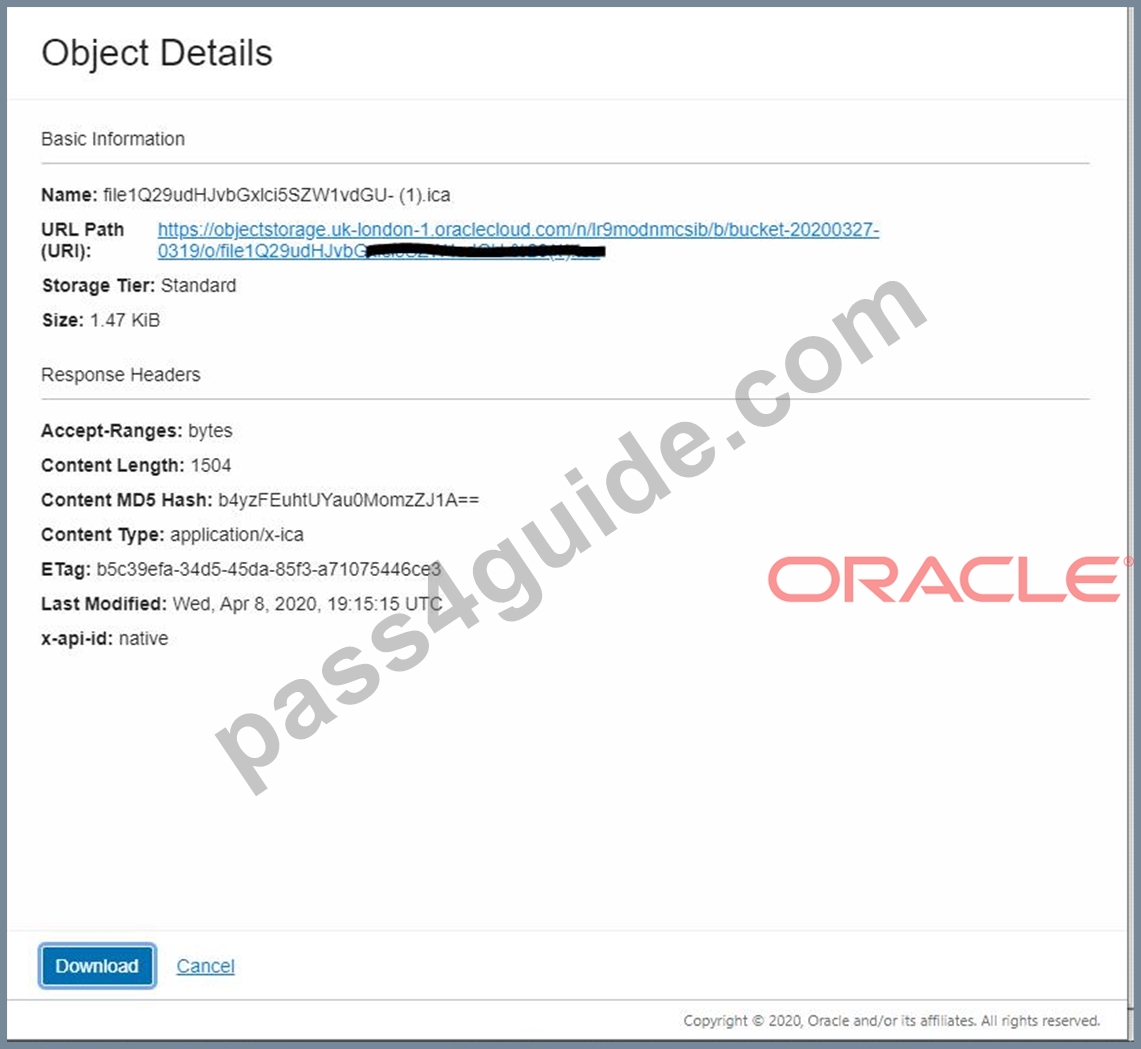
NEW QUESTION 149
Which two options are necessary for achieving high availability on Oracle Cloud Infrastructure?
- A. Store your database across multiple regions so that half of the data resides in one region and the other half resides in another region.
- B. Store your database files on Object Storage so that they are available in all Availability Domains in all regions.
- C. Distribute your application servers across all Availability Domains within a region.
- D. Attach your block volume form Availability Domain 1 to a compute instance in Availability Domain 2 (and vice versa) so that they are highly available.
- E. Configure your database to have Data Guard in another Availability Domain in Sync mode within a region.
Answer: C,E
Explanation:
Explanation
All details can find in "Best Practices for Deploying High Availability Architecture on Oracle Cloud Infrastructure"
https://docs.cloud.oracle.com/en-us/iaas/Content/Resources/Assets/whitepapers/best-practices-deploying-ha-arch
NEW QUESTION 150
Which two tagging related items are valid attributes that may be included in payload of an audit log event? (Choose two.)
- A. Tag variables
- B. Predefined values
- C. Default tags
- D. Cost-tracking tags
- E. Free-form tags
- F. Defined tags
Answer: E,F
Explanation:
Reference:
https://docs.cloud.oracle.com/en-us/iaas/Content/Audit/Reference/logeventreference.htm#payload
NEW QUESTION 151
You have five different company locations spread across the US. For a proof-of-concept (POC) you need to setup secure and encrypted connectivity to your workloads running in a single virtual cloud network (VCN) in the Oracle Cloud Infrastructure Ashburn region from all company locations.
What would meet this requirement?
- A. Create five virtual circuits using FastConnect for each company location and terminate those connections on a single dynamic routing gateway (DRG). Attach that DRG to your VCN.
- B. Create five IPsec connections with each company location and terminate those connections on a single DRG. Attach that DRG to your VCN.
- C. Create five internet gateways in your VCN and have separate route table for each internet gateway.
- D. Create five IPsec VPN connections with each company location and terminate those connections on five separate DRGs. Attach those DRGs to your VCN.
Answer: B
Explanation:
Explanation
Access to Your On-Premises Network
There are two ways to connect your on-premises network to Oracle Cloud Infrastructure:
VPN Connect: Offers multiple IPSec tunnels between your existing network's edge and your VCN, by way of a DRG that you create and attach to your VCN.
Oracle Cloud Infrastructure FastConnect: Offers a private connection between your existing network's edge and Oracle Cloud Infrastructure. Traffic does not traverse the internet. Both private peering and public peering are supported. That means your on-premises hosts can access private IPv4 addresses in your VCN as well as regional public IPv4 addresses in Oracle Cloud Infrastructure (for example, Object Storage or public load balancers in your VCN).
You can use one or both types of the preceding connections. If you use both, you can use them simultaneously, or in a redundant configuration. These connections come to your VCN by way of a single DRG that you create and attach to your VCN. Without that DRG attachment and a route rule for the DRG, traffic does not flow between your VCN and on-premises network. At any time, you can detach the DRG from your VCN but maintain all the remaining components that form the rest of the connection. You could then reattach the DRG again, or attach it to another VCN.
NEW QUESTION 152
You provisioned an Oracle Autonomous Data Warehouse (ADW) on Oracle Cloud Infrastructure (OCI) and imported data into ADW.
You want to give your business analyst the ability to connect to the ADW database and run queries.
Which two actions can help you meet this requirement? (Choose two.)
- A. Grant the predefined database role DWUSER to the database user.
- B. Grant the predefined database role DWROLE to the database user.
- C. Grant unlimited tablespace privilege to the database user.
- D. Grant the predefined database role DWADW to the database user.
- E. Create a database user account for the business analyst.
Answer: B,C
Explanation:
Reference:
https://oracle.github.io/learning-library/oci-library/L100-LAB/Autonomous_Data_Warehouse/ADW_HOL.html
NEW QUESTION 153
You are running a mission-critical database application in Oracle Cloud Infrastructure (OCI). You take regular backups of your DB system to OCI object storage. Recently, you notice a failed database backup status in the console.
What step can you take to determine the cause of the backup failure?
- A. Ensure the database archiving mode is set to NOARCHIVELOG.
- B. Ensure that your database host can connect to OCI object storage.
- C. Don't restart the dcsagent program even if it has a status of stop/waiting.
- D. Make sure that the database is not active and running while the backup is in progress.
Answer: B
Explanation:
Database backups can fail for various reasons. Typically, a backup fails because either the database host cannot access the object store, or there are problems on the host or with the database configuration.
First need to determining the Problem
In the Console, a failed database backup either displays a status of Failed or hangs in the Backup in Progress or Creating state. If the error message does not contain enough information to point you to a solution, you can use the database CLI and log files to gather more data. Then, refer to the applicable section in this topic for a solution.
Database Service Agent Issues
Your Oracle Cloud Infrastructure Database makes use of an agent framework to allow you to manage your database through the cloud platform. Occasionally you might need to restart the dcsagent program if it has the status of stop/waiting to resolve a backup failure.
Object Store Connectivity Issues
Backing up your database to Oracle Cloud Infrastructure Object Storage requires that the host can connect to the applicable Swift endpoint. You can test this connectivity by using a Swift user.
Host Issues
One or more of the following conditions on the database host can cause backups to fail:
- Interactive Commands in the Oracle Profile
- The File System Is Full
- Incorrect Version of the Oracle Database Cloud Backup Module
- Changes to the Site Profile File (glogin.sql)
Database Issues
An improper database state or configuration can lead to failed backups.
- Database Not Running During Backup
- Archiving Mode Set to NOARCHIVELOG (When you provision a new database, the archiving mode is set to ARCHIVELOG by default. This is the required archiving mode for backup operations)
- Stuck Database Archiver Process and Backup Failures
- Temporary Tablespace Errors
- RMAN Configuration and Backup Failures
- RMAN Retention Policy and Backup Failures
- Loss of Objectstore Wallet File and Backup Failures
TDE Wallet and Backup Failures
- Incorrect TDE Wallet Location Specification
- Incorrect State of the TDE Wallet
- Incorrect Configuration Related to the TDE Wallet
- Missing TDE Wallet File
As this is not new provisioned database and already in the ARCHIVELOG , regular backups of DB system to OCI object storage in places, so the best answers are,
- Ensure that your database host can connect to the OCI object storage
- Restart the database service agent
NEW QUESTION 154
What is the default backup location for database backup on Database Cloud Service (DBCS)?
- A. ASM diskgroup
- B. locally attached NVMe on Virtual Machine
- C. Object Storage on Oracle Cloud Infrastructure
- D. block volume
Answer: C
Explanation:
Explanation
References: https://docs.oracle.com/en/cloud/paas/database-dbaas-cloud/csdbi/backing.html
NEW QUESTION 155
You are responsible for creating and maintaining an enterprise application that consists of multiple storage volumes across multiple instances. The storage volumes include boot volumes and block volumes for your data storage. You need to create backups of these storage volumes in the most time-efficient manner.
How can you meet this requirement?
- A. You can create clones of storage volumes one at a time
- B. You can create on-demand one-off backups of boot volumes, but not block volumes
- C. You can create on-demand one-off backups of block volumes, but not boot volumes
- D. You can group together multiple storage volumes in a volume group and create volume group backups
Answer: D
NEW QUESTION 156
......
Pass Your 1Z0-1072-20 Exam Easily With 100% Exam Passing Guarantee: https://www.pass4guide.com/1Z0-1072-20-exam-guide-torrent.html