


Pass Your Exam With 100% Verified OGEA-101 Exam Questions
OGEA-101 Dumps PDF - OGEA-101 Real Exam Questions Answers
NEW QUESTION # 55
Consider the illustration.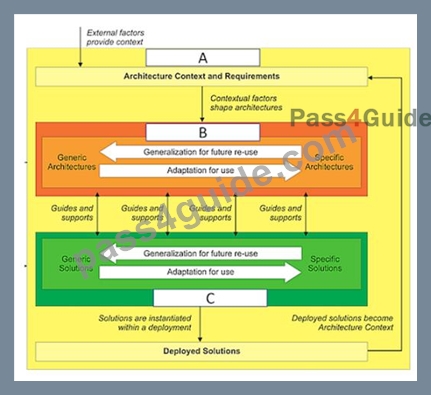
What are the items labelled A, B and C?
- A. A-Enterprise Strategic Architecture, B-Segment Architecture, C-Solutions Architecture
- B. A-Architecture Vision, B-Business Architecture, C-Information Systems Architecture
- C. A-Enterprise Continuum, B-Architecture Continuum, C-Solutions Continuum
- D. A-Enterprise Architecture, B-Architecture Building Blocks, C-Solutions Building Blocks
Answer: C
Explanation:
The illustration shows the relationship between the Enterprise Continuum, the Architecture Continuum, and the Solutions Continuum, which are key concepts in the TOGAF framework. The Enterprise Continuum is a view of the Architecture Repository that shows how generic foundation architectures can be leveraged and specialized to support the requirements of an individual organization. The Architecture Continuum specifies a structured classification for architectural artifacts, such as models, patterns, and descriptions, that can be reused and adapted across different domains and levels of abstraction. The Solutions Continuum identifies implemented solutions that support various stages of business and IT capability evolution, such as common systems, industry solutions, and organization-specific solutions. The illustration also shows how the architecture context and requirements are influenced by external factors, such as business drivers, stakeholders, and standards, and how they shape the generic and specific architectures and solutions. The illustration also shows how the deployed solutions become part of the architecture context for future iterations of the architecture development cycle. Reference:
* TOGAF Standard, 10th Edition, Part II: Architecture Development Method, Chapter 6: Architecture Repository, Section 6.2 Enterprise Continuum.
* TOGAF Standard, 10th Edition, Part IV: Architecture Content Framework, Chapter 35: Enterprise Continuum and Tools, Section 35.1 Introduction.
NEW QUESTION # 56
Which of the following are interests important to the stakeholders in a system?
- A. Concerns
- B. Principles
- C. Architecture views
- D. Requirements
Answer: A
Explanation:
Concerns are interests important to the stakeholders in a system. They are used to identify and classify the system's stakeholders and to guide the selection of viewpoints for the architecture description. Reference: The TOGAF Standard | The Open Group Website, Section 3.2.1 Architecture Viewpoints
NEW QUESTION # 57
What is used to structure architectural information in an orderly way so that it can be processed to meet stakeholder needs?
- A. A Stakeholder Map
- B. An Architecture Framework
- C. Content Metamodel
- D. An EA Library
Answer: C
Explanation:
* A content metamodel is a formal structure that defines the types of entities and relationships that are used to capture, store, filter, query, and represent architectural information in a way that supports consistency, completeness, and traceability12.
* A stakeholder map is a tool that identifies and analyzes the key stakeholders and their interests, influence, and expectations in relation to the architecture3. It is not used to structure architectural information, but rather to understand the stakeholder needs and concerns.
* An architecture framework is a set of principles, guidelines, standards, and tools that provide a common structure and methodology for developing architectures4. It is not used to structure architectural information, but rather to guide the architecture development process and ensure alignment with the business strategy and objectives.
* An EA library is a repository that stores and manages the architecture artifacts, deliverables, and other relevant information produced and consumed during the architecture development and governance. It is not used to structure architectural information, but rather to provide access, security, and version control for the architecture content.
NEW QUESTION # 58
Consider the following statements.
1. All processes, decision-making, and mechanisms used will be established so as to minimize or avoid potential conflicts of interest.
2. More effective strategic decision-making will be made by C-Level executives and business leaders.
3. All actions implemented and their decision support will be available for inspection by authorized organization and provider parties.
4. Digital Transformation and operations will be more effective and efficient.
Which statements highlight the value and necessity for Architecture Governance to be adopted within organizations?
- A. 2& 3
- B. 1 & 3
- C. 1 & 4
- D. 2 & 4
Answer: B
Explanation:
Statements 1 and 3 highlight the value and necessity for Architecture Governance to be adopted within organizations. Architecture Governance is the practice and orientation by which Enterprise Architectures and other architectures are managed and controlled at an enterprise-wide level12. It ensures that architectural decisions are aligned with the organization's strategy, objectives, and standards. Architecture Governance also involves establishing and maintaining processes, decision-making, and mechanisms to avoid or minimize potential conflicts of interest, such as between different stakeholders, business units, or projects34. Moreover, Architecture Governance requires transparency and accountability for all actions implemented and their decision support, so that they can be inspected and evaluated by authorized parties, such as auditors, regulators, or customers5 . Reference:
* The TOGAF Standard, Version 9.2 - Architecture Governance - The Open Group
* Architecture Governance - The Open Group
* Tutorial: Governance in TOGAF's Architecture Development Method (ADM)
* Architecture Governance in TOGAF: Ensuring Effective Management and Compliance
* The TOGAF Standard, Version 9.2 - Definitions - The Open Group
* [Architecture Governance in TOGAF: Ensuring Alignment and Control]
NEW QUESTION # 59
Consider the following ADM phases objectives.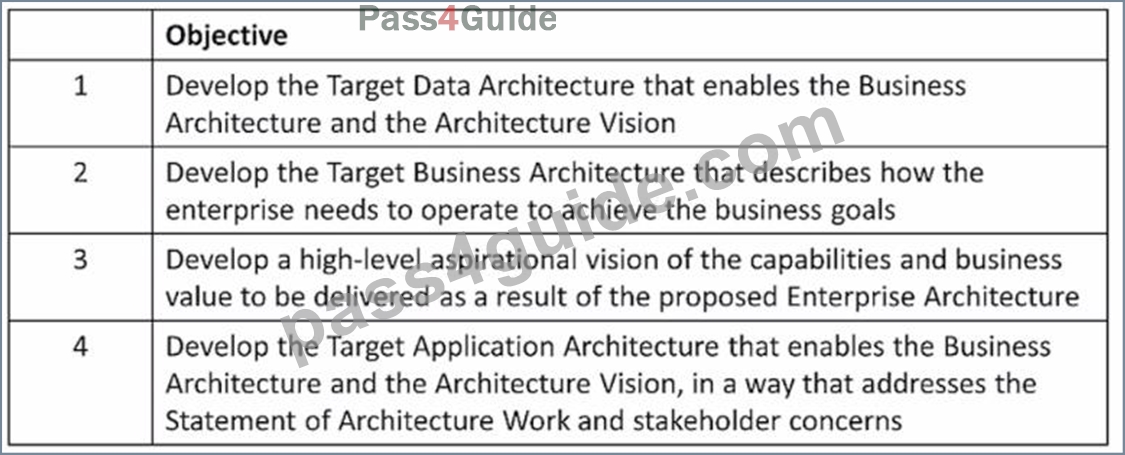
Which phase does each objective match?
- A. 1A-2B-3C-4D
- B. 1C-2D-3B-4A
- C. 1B-2D-3A-4C
- D. 1C-2B-3A-4C
Answer: D
Explanation:
The objectives listed in the question correspond to the objectives of different phases of the TOGAF ADM (Architecture Development Method), which is a method for developing and managing an enterprise architecture1.
The ADM consists of nine phases, each with a specific purpose and output. The phases are1:
Preliminary Phase: To prepare and initiate the architecture development cycle, including defining the architecture framework, principles, and governance.
Phase A: Architecture Vision: To define the scope, vision, and stakeholders of the architecture initiative, and to obtain approval to proceed.
Phase B: Business Architecture: To describe the baseline and target business architecture, and to identify the gaps between them.
Phase C: Information Systems Architectures: To describe the baseline and target data and application architectures, and to identify the gaps between them.
Phase D: Technology Architecture: To describe the baseline and target technology architecture, and to identify the gaps between them.
Phase E: Opportunities and Solutions: To identify and evaluate the opportunities and solutions for implementing the target architecture, and to define the work packages and transition architectures.
Phase F: Migration Planning: To finalize the implementation and migration plan, and to ensure alignment with the enterprise portfolio and project management.
Phase G: Implementation Governance: To provide architecture oversight and guidance for the implementation projects, and to manage any architecture change requests.
Phase H: Architecture Change Management: To monitor the changes in the business and technology environment, and to assess the impact and performance of the architecture.
Based on the above definitions, we can match each objective with the corresponding phase as follows:
Objective 1: Develop the Target Data Architecture that enables the Business Architecture and the Architecture Vision. This objective is achieved in Phase C: Information Systems Architectures, where the data architecture is defined as a subset of the information systems architecture2.
Objective 2: Develop the Target Business Architecture that describes how the enterprise needs to operate to achieve the business goals. This objective is achieved in Phase B: Business Architecture, where the business architecture is defined as a subset of the enterprise architecture3.
Objective 3: Develop a high-level aspirational vision of the capabilities and business value to be delivered as a result of the proposed Enterprise Architecture. This objective is achieved in Phase A: Architecture Vision, where the architecture vision is defined as a high-level description of the target architecture and its benefits4.
Objective 4: Develop the Target Application Architecture that enables the Business Architecture and the Architecture Vision, in a way that addresses the Statement of Architecture Work and stakeholder concerns. This objective is achieved in Phase C: Information Systems Architectures, where the application architecture is defined as a subset of the information systems architecture2.
Reference:
1: The TOGAF Standard, Version 9.2, Chapter 5: Architecture Development Method (ADM)
2: The TOGAF Standard, Version 9.2, Chapter 9: Phase C: Information Systems Architectures
3: The TOGAF Standard, Version 9.2, Chapter 8: Phase B: Business Architecture
4: The TOGAF Standard, Version 9.2, Chapter 7: Phase A: Architecture Vision
NEW QUESTION # 60
Which phase of the ADM has the purpose to develop an Enterprise Architecture Capability?
- A. Phase G
- B. Preliminary Phase
- C. Phase A
- D. Phase B
Answer: B
Explanation:
According to the TOGAF Standard, 10th Edition, the Preliminary Phase of the Architecture Development Method (ADM) has the purpose to develop an Enterprise Architecture Capability 1. An Enterprise Architecture Capability is the ability of the organization to perform the activities and tasks related to Enterprise Architecture, such as defining the scope, principles, vision, governance, and stakeholders of the architecture. The Preliminary Phase also establishes the architecture framework, the architecture repository, the architecture tools, and the architecture team 1. The other options are not correct, as they have different purposes in the ADM. Phase G: Implementation Governance has the purpose to ensure that the implementation projects conform to the target architecture 2. Phase A: Architecture Vision has the purpose to define the scope, stakeholders, business drivers, and objectives of the architecture project 3. Phase B: Business Architecture has the purpose to describe the baseline and target business architecture, and to identify the gaps between them . Reference: 1: TOGAF Standard, 10th Edition, Part II: Architecture Development Method, Chapter 6: Preliminary Phase. 2: TOGAF Standard, 10th Edition, Part II: Architecture Development Method, Chapter 18: Phase G: Implementation Governance. 3: TOGAF Standard, 10th Edition, Part II: Architecture Development Method, Chapter 12: Phase A: Architecture Vision. : TOGAF Standard, 10th Edition, Part II: Architecture Development Method, Chapter 13: Phase B: Business Architecture.
NEW QUESTION # 61
Complete the sentence. The four purposes that typically frame the planning horizon, depth and breadth of an Architecture Project, and the contents of the EA Repository are Strategy, Portfolio,
- A. Segment, and End-to-end Target Architecture.
- B. Discreet, and Cohesive.
- C. Project, and Solution Delivery.
- D. Subordinate, and Superior Architecture.
Answer: A
Explanation:
The planning horizon, depth, and breadth of an Architecture Project, along with the contents of the EA Repository, are typically framed by Strategy, Portfolio, Segment, and End-to-end Target Architecture. The 'Segment' refers to a part of the organization, typically addressed in a Segment Architecture, while 'End-to-end Target Architecture' encompasses the complete view of the planned architecture across the entire organization.
NEW QUESTION # 62
Consider the following descriptions of deliverables consumed and produced across the TOGAF ADM cycle.
General rules and guidelines, intended to be enduring and seldom
amended, that inform and support the way in which an organization sets
about fulfilling its mission
The joint agreements between development partners and sponsors on the
deliverables, quality, and fitness-for-purpose of an architecture.
A document that is sent from the sponsoring organization to the
architecture organization to trigger the start of an architecture
development cycle
A set of quantitative statements that outline what an implementation
project must do in order to comply with the architecture.
Which deliverables match these descriptions?
- A. 1 Architecture Requirements Specification -2 Architecture Principles - 3 Architecture Vision - 4 Architecture Contracts
- B. 1 Architecture Contracts - 2 Architecture Requirements Specification - 3 Architecture Vision - 4 Architecture Principles
- C. 1 Architecture Principles -2 Architecture Contracts - 3 Request for Architecture Work - 4 Architecture Requirements Specification
- D. 1 Architecture Principles -2 Architecture Contracts - 3 Architecture Requirements Specification-4 Request for Architecture Work
Answer: C
Explanation:
According to the TOGAF standard, the deliverables that match the descriptions are as follows:
1 Architecture Principles: These are general rules and guidelines, intended to be enduring and seldom amended, that inform and support the way in which an organization sets about fulfilling its mission1. They reflect a level of consensus among the various elements of the enterprise, and form the basis for making future IT decisions1.
2 Architecture Contracts: These are the joint agreements between development partners and sponsors on the deliverables, quality, and fitness-for-purpose of an architecture2. They are used to ensure that the architecture is implemented and governed according to the agreed-upon specifications and standards2.
3 Request for Architecture Work: This is a document that is sent from the sponsoring organization to the architecture organization to trigger the start of an architecture development cycle3. It defines the scope, schedule, budget, deliverables, and stakeholders of the architecture project3.
4 Architecture Requirements Specification: This is a set of quantitative statements that outline what an implementation project must do in order to comply with the architecture4. It defines the requirements for each architecture domain, as well as the relationships and dependencies among them4.
NEW QUESTION # 63
Which statement about Requirements Management is most correct?
- A. Stakeholder requirements are captured once in Phase A and managed throughout the ADM cycle
- B. Requirements Management and stakeholder engagement are placed at the center of architecture development
- C. Requirements Management is a step of all ADM Phases
- D. The purpose of Requirements Management is to process change requests
Answer: B
Explanation:
This statement about Requirements Management is most correct because it reflects the central role of Requirements Management and stakeholder engagement in the ADM cycle. Requirements Management is not a step of all ADM Phases, but rather an ongoing process that ensures that all relevant requirements are elicited, analyzed, prioritized, and addressed throughout the architecture development and transition. Stakeholder engagement is also a continuous activity that involves identifying, communicating, and managing stakeholder expectations and concerns. Reference: The TOGAF Standard | The Open Group Website, Section 3.1 Introduction to the ADM.
NEW QUESTION # 64
When considering the scope of an architecture, what dimension considers to what level of detail the architecting effort should go?
- A. Project
- B. Breadth
- C. Depth
- D. Architecture Domains
Answer: C
Explanation:
The scope of an architecture is the extent and level of detail of the architecture work. The scope of an architecture can be defined along four dimensions: project, breadth, depth, and architecture domains. The project dimension considers the boundaries and objectives of the architecture project, such as the time frame, budget, resources, and deliverables. The breadth dimension considers the coverage and completeness of the architecture across the enterprise, such as the organizational units, business functions, processes, and locations. The depth dimension considers the level of detail and specificity of the architecture, such as the granularity, abstraction, and precision of the architectural elements and relationships. The architecture domains dimension considers the aspects or segments of the architecture, such as the business, data, application, and technology domains.
Therefore, the depth dimension is the one that considers to what level of detail the architecting effort should go.
NEW QUESTION # 65
Consider the following statements:
1. Each contracted party is required to act responsibly to the organization and its stakeholders.
2. All decisions taken, processes used, and their implementation will not be allowed to create unfair advantage to any one particular party.
3. Digital Transformation and operations will be more effective and efficient.
4. Strategic decision-making by C-Level executives and business leaders will be more effective.
Which statements highlight the value and necessity for Architecture Governance to be adopted within organizations?
- A. 3 & 4
- B. 1 & 2
- C. 2 & 3
- D. 1 & 4
Answer: B
Explanation:
Architecture governance is the practice of ensuring compliance with the enterprise architecture and its principles, standards, and goals. Architecture governance provides the means to establish, monitor, and control the architecture development and implementation processes, and to resolve any issues or conflicts that may arise. Architecture governance also ensures that all stakeholders are represented and involved in the decision-making process, and that their interests and concerns are balanced and aligned. Statements 1 and 2 highlight the value and necessity for architecture governance to be adopted within organizations, as they emphasize the importance of responsibility, accountability, fairness, and transparency in the architectural activities. Statements 3 and 4 are more related to the benefits and outcomes of having a good enterprise architecture, rather than the governance aspect.Reference: : The TOGAF Standard, Version 9.2, Part VI: Architecture Capability Framework, Chapter 50: Architecture Governance : The TOGAF Standard, Version 9.2, Part III: ADM Guidelines and Techniques, Chapter 29: Architecture Governance
NEW QUESTION # 66
Complete the sentence. The key purpose of Gap Analysis is to _____
- A. establish quality parameters for the architecture
- B. validate nonfunctional requirements
- C. identify commercial building blocks to be purchased
- D. identify potential missing or overlapping functions
- E. determine the required service levels for the architecture
Answer: D
Explanation:
Gap Analysis is a technique that compares the Baseline Architecture and the Target Architecture to identify the differences and gaps between them. The purpose of this technique is to determine the changes and additions that are required to achieve the desired future state of the architecture. One of the main aspects of Gap Analysis is to identify the functions that are missing or overlapping in the current and future architectures, and to plan how to address them. This helps to ensure that the architecture is complete, consistent, and aligned with the business objectives and requirements3
NEW QUESTION # 67
Which of the following best describes a purpose of the Gap Analysis technique?
- A. To determine service levels for the architecture
- B. To identify missing functions
- C. To validate non-functional requirements
- D. To establish quality metrics for the architecture
Answer: B
Explanation:
Gap analysis is a technique that is used to validate an architecture by highlighting the shortfall between the Baseline Architecture and the Target Architecture. One of the purposes of gap analysis is to identify missing functions that are either deliberately omitted, accidentally left out, or not yet defined in the Target Architecture. Missing functions are marked as gaps that need to be filled by developing or procuring the building blocks.
NEW QUESTION # 68
What does the TOGAF ADM recommend for use in developing an Architecture Vision document?
- A. Business Scenarios
- B. Gap Analysis
- C. Architecture Principles
- D. Requirements Management
Answer: A
Explanation:
Business scenarios are a technique recommended by the TOGAF ADM for use in developing an Architecture Vision document12. Business scenarios are a means of capturing the business requirements and drivers, the processes and actors involved, and the desired outcomes and measures of success34. Business scenarios help to create a common vision and understanding among the stakeholders, and to identify and validate the architecture requirements . Business scenarios also provide a basis for analyzing the impact and value of the proposed architecture. Reference:
* The TOGAF Standard, Version 9.2 - Phase A: Architecture Vision - The Open Group
* TOGAF Standard - Introduction - Phase A: Architecture Vision
* The TOGAF Standard, Version 9.2 - Definitions - The Open Group
* Business Scenarios - The Open Group
* [The TOGAF Standard, Version 9.2 - Architecture Requirements Specification - The Open Group]
* [The TOGAF Standard, Version 9.2 - Architecture Vision - The Open Group]
* [The TOGAF Standard, Version 9.2 - Business Transformation Readiness Assessment - The Open Group]
NEW QUESTION # 69
Consider the following ADM phases objectives.
Which phase does each objective match?
- A. 1F-2G-3G-4H
- B. 1G-2H-3H-4F
- C. 1H-2F-3F-4G
- D. 1F-2G-3H-4H
Answer: C
Explanation:
According to the TOGAF Standard, Version 9.2, the ADM phases and their objectives are as follows1:
Preliminary Phase: To prepare and initiate the architecture development cycle, including defining the architecture framework, principles, and governance.
Phase A: Architecture Vision: To define the scope, vision, and stakeholders of the architecture initiative, and to obtain approval to proceed.
Phase B: Business Architecture: To describe the baseline and target business architecture, and to identify the gaps between them.
Phase C: Information Systems Architectures: To describe the baseline and target data and application architectures, and to identify the gaps between them.
Phase D: Technology Architecture: To describe the baseline and target technology architecture, and to identify the gaps between them.
Phase E: Opportunities and Solutions: To identify and evaluate the opportunities and solutions for implementing the target architecture, and to define the work packages and transition architectures.
Phase F: Migration Planning: To finalize the implementation and migration plan, and to ensure alignment with the enterprise portfolio and project management.
Phase G: Implementation Governance: To provide architecture oversight and guidance for the implementation projects, and to manage any architecture change requests.
Phase H: Architecture Change Management: To monitor the changes in the business and technology environment, and to assess the impact and performance of the architecture.
Requirements Management: To manage the architecture requirements throughout the ADM cycle, and to ensure alignment with the business requirements.
Based on the above definitions, we can match each objective with the corresponding phase as follows:
Objective 1: Ensure that the business value and cost of work packages and transition architectures is understood by key stakeholders. This objective is achieved in Phase H: Architecture Change Management, where the value realization and cost-benefit analysis of the architecture are performed2.
Objective 2: Ensure conformance with the Target Architecture by implementation projects. This objective is achieved in Phase F: Migration Planning, where the conformance requirements and criteria for the implementation projects are defined3.
Objective 3: Ensure that the architecture development cycle is maintained. This objective is achieved in Phase F: Migration Planning, where the architecture roadmap and iteration cycle are maintained3.
Objective 4: Ensure that the Architecture Governance Framework is executed. This objective is achieved in Phase G: Implementation Governance, where the architecture governance processes and procedures are applied to the implementation projects4.
Reference:
1: The TOGAF Standard, Version 9.2, Chapter 5: Architecture Development Method (ADM)
2: The TOGAF Standard, Version 9.2, Chapter 21: Architecture Change Management
3: The TOGAF Standard, Version 9.2, Chapter 20: Migration Planning
4: The TOGAF Standard, Version 9.2, Chapter 19: Implementation Governance
NEW QUESTION # 70
Complete the following sentence. In the ADM documents which are under development and have not undergone any formal review and approval process are_______________.
- A. In between phases
- B. Known as ''Version 0.1''
- C. Invalid
- D. Called ''draft''
Answer: D
Explanation:
In the ADM documents which are under development and have not undergone any formal review and approval process are called "draft". This indicates that they are subject to change and refinement as the architecture development progresses. Reference: The TOGAF Standard | The Open Group Website, Section 4.2.5 Architecture Deliverables.
NEW QUESTION # 71
Which of the following are the four purposes that typically frame the planning horizon, depth and breadth of an Architecture Project, and the contents of the EA Repository-?
- A. General Foundational Subordinate and Superior Architecture
- B. Segment, Capability. Enterprise and End-to-end Target Architecture
- C. Avant-Garde Big-Bang, Discreet and Cohesive
- D. Strategy Portfolio Project Solution Delivery
Answer: D
NEW QUESTION # 72
Complete the sentence The Enterprise Continuum provides methods for classifying architecture artifacts as they evolve from________________________.
- A. Solutions Architectures to Solution Building Blocks
- B. Foundation Architectures to re-usable architecture assets
- C. generic architectures to reusable Solution Building Blocks
- D. generic architectures to Organization-Specific Architectures
Answer: D
Explanation:
The Enterprise Continuum provides methods for classifying architecture artifacts as they evolve from generic architectures to Organization-Specific Architectures. Generic architectures are architectures that have been developed for use across a wide range of enterprises with similar characteristics. They provide common models, functions, and services that can be reused and adapted for specific purposes. Organization-Specific Architectures are architectures that have been tailored to meet the needs and requirements of a particular enterprise or a major organizational unit within an enterprise. They reflect the unique vision, goals, culture, structure, processes, systems, and technologies of that enterprise or unit. Reference: The TOGAF Standard | The Open Group Website, Section 2.3 Enterprise Continuum.
NEW QUESTION # 73
What can architects present to stakeholders to extract hidden agendas, principles, and requirements that could impact the final Target Architecture?
- A. Alternatives and Trade-offs
- B. Solutions and Applications
- C. Architecture Views and Architecture Viewpoints
- D. Business Scenarios and Business Models
Answer: C
Explanation:
* According to the TOGAF Standard, Version 9.2, an architecture view is a representation of a system from the perspective of a related set of concerns1. It consists of one or more architecture models that demonstrate how the system addresses the stakeholder concerns1.
* An architecture viewpoint is a specification of the conventions for constructing and using an architecture view to address specific stakeholder concerns1. It defines the perspective, scope, notation, and techniques for creating an architecture view of a system1.
* Architects can present architecture views and viewpoints to stakeholders to extract hidden agendas, principles, and requirements that could impact the final Target Architecture, because23:
oArchitecture views and viewpoints help to communicate and visualize the architecture in a way that is meaningful and relevant to different stakeholders, addressing their specific interests and needs.
oArchitecture views and viewpoints help to elicit and validate the stakeholder concerns and requirements, ensuring that they are aligned with the business goals and objectives, and that they are consistent and feasible within the architecture context.
oArchitecture views and viewpoints help to identify and resolve any conflicts, gaps, or trade-offs among the stakeholder concerns and requirements, ensuring that they are balanced and prioritized in the architecture design and decision-making.
oArchitecture views and viewpoints help to demonstrate and verify the value and benefits of the architecture to the stakeholders, ensuring that they are satisfied and committed to the architecture outcome and governance.
Reference:
* 1: The TOGAF Standard, Version 9.2, Chapter 22: Architecture Views, Viewpoints, and Stakeholders
* 2: The TOGAF Standard, Version 9.2, Chapter 4: Introduction to Part II, Section 4.2: What is an Architecture Framework?
* 3: The TOGAF Standard, Version 9.2, Chapter 31: Architectural Artifacts, Section 31.1: Basic Concepts
NEW QUESTION # 74
Exhibit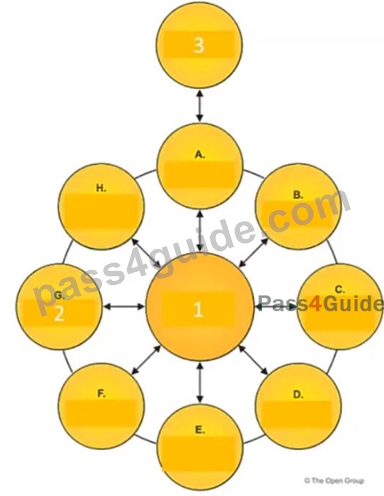
Consider the illustration showing an architecture development cycle Which description matches the phase of the ADM labeled as item 2?
- A. Establishes procedures for managing change to the new architecture
- B. Operates the process of managing architecture requirements
- C. Provides architectural oversight for the implementation
- D. Conducts implementation planning for the architecture defined in previous phases
Answer: C
Explanation:
Based on the illustration, the phase of the ADM labeled as item 2 is the Implementation Governance phase. This phase provides architectural oversight for the implementation. It ensures that the implementation project conforms to the architecture. It also provides a framework for monitoring and managing the implementation.
The Implementation Governance phase involves the following activities:
* Finalizing the Architecture Roadmap and the supporting Implementation and Migration Plan
* Assigning an Architecture Board to oversee the implementation
* Establishing Architecture Contracts with the implementation partners
* Reviewing and approving the implementation project plans and deliverables
* Performing Architecture Compliance reviews to ensure alignment with the architecture
* Performing Architecture Audit reviews to ensure quality and performance of the architecture
* Resolving any architecture issues or change requests that arise during the implementation
* Maintaining the architecture lifecycle and ensuring its continuity
The Implementation Governance phase is essential for ensuring that the architecture is realized as intended and that it delivers the expected business value and outcomes.
NEW QUESTION # 75
Which of the following statements about architecture partitioning are correct*?
1 Partitions are used to simplify the management of the Enterprise Architecture
2 Partitions are equivalent to architecture levels
3 Partitions enable different teams to work on different element of the architecture at the same time.
4 Partitions reflect the organization's structure
- A. 2 & 3
- B. 1 & 3
- C. 1 & 4
- D. 2 & 4
Answer: B
Explanation:
Statements 1 and 3 about architecture partitioning are correct. Architecture partitioning is the technique of dividing an architecture into smaller and more manageable parts that can be developed, maintained, and governed independently. Partitions are used to simplify the management of the Enterprise Architecture and to enable different teams to work on different elements of the architecture at the same time. Partitions are not equivalent to architecture levels, which are different degrees of abstraction or detail in an architecture. Partitions do not necessarily reflect the organization's structure, which may change over time or differ from the architecture's scope and boundaries. Reference: The TOGAF Standard | The Open Group Website, Section 2.5 Architecture Partitioning.
NEW QUESTION # 76
Refer to the table below: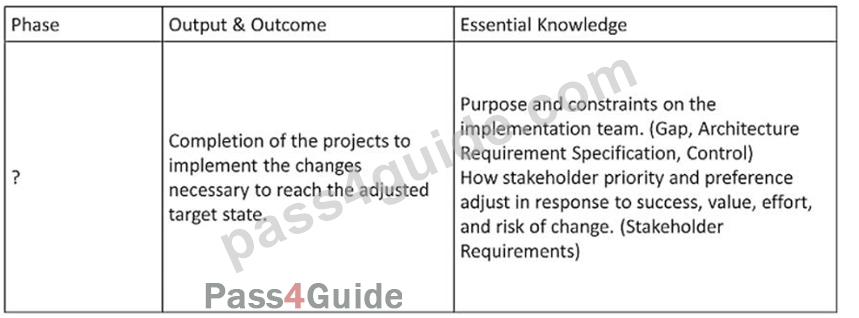
Which ADM Phase does this describe?
- A. Phase G
- B. Phase F
- C. Phase E
- D. Phase A
Answer: A
Explanation:
The table describes the output, outcome, and essential knowledge of an ADM phase that oversees the implementation of changes necessary to reach the adjusted target state. This corresponds to Phase G, also known as Implementation Governance, which ensures that the architecture defined in earlier phases is realized, and it oversees the development and implementation of projects to align with this architecture. The essential knowledge required during this phase includes understanding constraints on the implementation team and adjusting stakeholder priority and preference in response to success, value, effort, and risk of change. Reference: TOGAF Version 9.1 - 1
NEW QUESTION # 77
......
OGEA-101 Dumps 100 Pass Guarantee With Latest Demo: https://www.pass4guide.com/OGEA-101-exam-guide-torrent.html
Prepare OGEA-101 Question Answers Free Update With 100% Exam Passing Guarantee [2024]: https://drive.google.com/open?id=1EBZTOU8ZKM9c7-hseA0BbhjKP3tHkj0j