


Get Real N10-008 Quesions Pass CompTIA Certification Exams Easily
N10-008 Dumps are Available for Instant Access
CompTIA N10-008 exam is intended for professionals who are seeking to advance their careers in network administration or for those who are new to the field. CompTIA Network+ Certification Exam certification is recommended for individuals who have at least nine months of experience in network support or administration, as well as for those who hold a CompTIA A+ certification or equivalent knowledge. N10-008 exam consists of 90 multiple-choice and performance-based questions that must be completed within 90 minutes. A passing score of 720 out of 900 is required to obtain the certification.
CompTIA N10-008 exam covers a wide range of topics, including network architecture, protocols, security, virtualization, and cloud computing. Candidates are expected to have a good understanding of network technologies and be able to troubleshoot network issues. N10-008 exam is designed to test the candidate's ability to configure, manage, and maintain network devices such as routers, switches, and firewalls.
CompTIA Network+ Exam Certification Details:
| Sample Questions | CompTIA Network+ Sample Questions |
| Exam Name | CompTIA Certified Network+ |
| Duration | 90 mins |
| Schedule Exam | CompTIA Marketplace Pearson VUE |
NEW QUESTION # 320
After a recent power outage, users are reporting performance issues accessing the application servers. Wireless users are also reporting intermittent Internet issues.
INSTRUCTIONS
Click on each tab at the top of the screen. Select a widget to view information, then use the drop-down menus to answer the associated questions. If at any time you would like to bring back the initial state of the simulation, please click the Reset All button.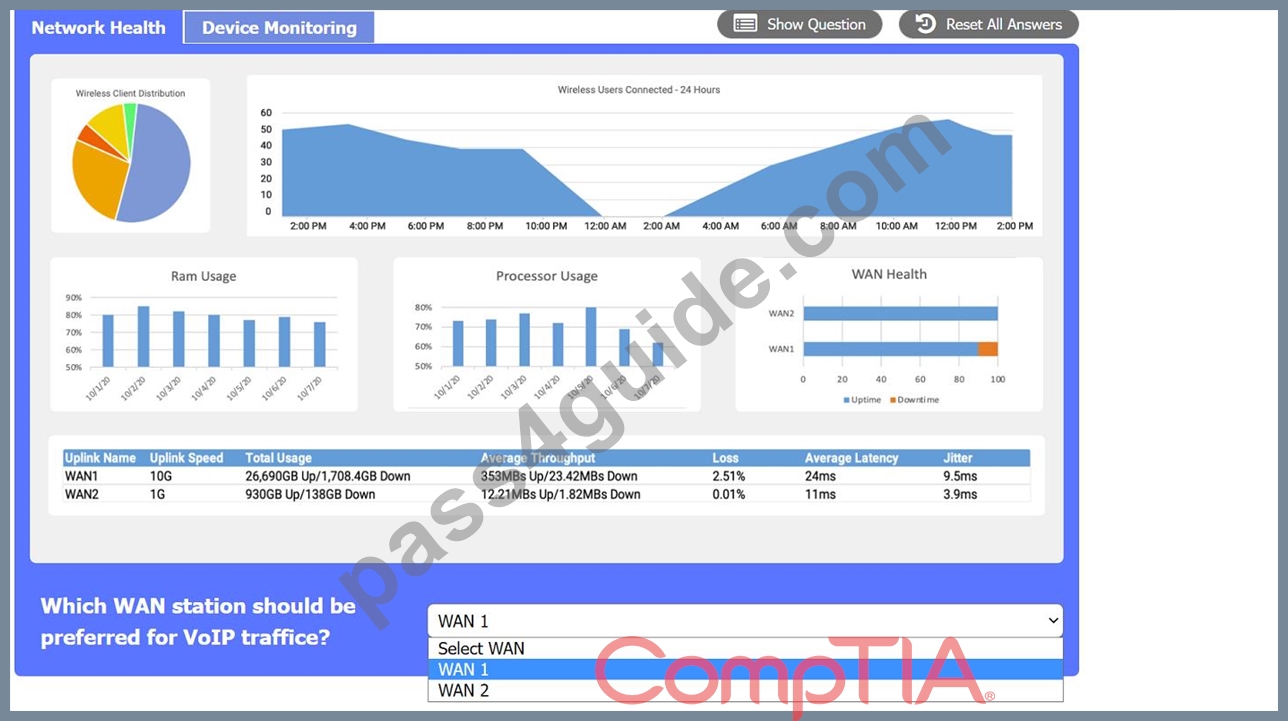
Answer:
Explanation:
See the answer and solution below in Explanation
Explanation:
Network Health:
WAN 2 appears to have a lower average latency and loss percentage, which would make it the preferred WAN station for VoIP traffic. VoIP traffic requires low latency and packet loss to ensure good voice quality and reliability. WAN 1 seems to have higher RAM and processor usage, which could also affect the performance of VoIP traffic.
Here's the summary of the key metrics for WAN 1 and WAN 2 from the image provided:
WAN 1:
Uplink Speed: 10G
Total Usage: 26.969GB Up / 1.748GB Down
Average Throughput: 353MBps Up / 23.42MBps Down
Loss: 2.51%
Average Latency: 24ms
Jitter: 9.5ms
WAN 2:
Uplink Speed: 1G
Total Usage: 930GB Up / 138GB Down
Average Throughput: 12.21MBps Up / 1.82MBps Down
Loss: 0.01%
Average Latency: 11ms
Jitter: 3.9ms
For VoIP traffic, low latency and jitter are particularly important to ensure voice quality. While WAN 1 has higher bandwidth and throughput, it also has higher latency and jitter compared to WAN 2. However, WAN 2 has much lower loss, lower latency, and lower jitter, which are more favorable for VoIP traffic that is sensitive to delays and variation in packet arrival times.
Given this information, WAN 2 would generally be preferred for VoIP traffic due to its lower latency, lower jitter, and significantly lower loss percentage, despite its lower bandwidth compared to WAN 1. The high bandwidth of WAN 1 may be more suitable for other types of traffic that are less sensitive to latency and jitter, such as bulk data transfers.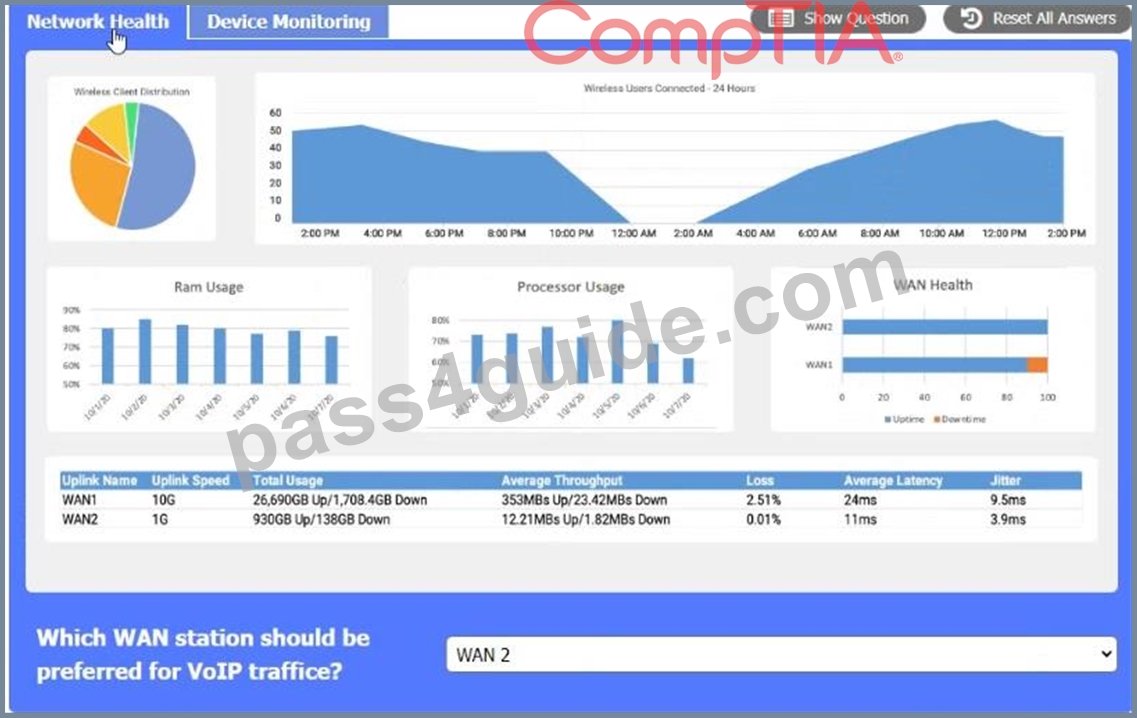
Device Monitoring:
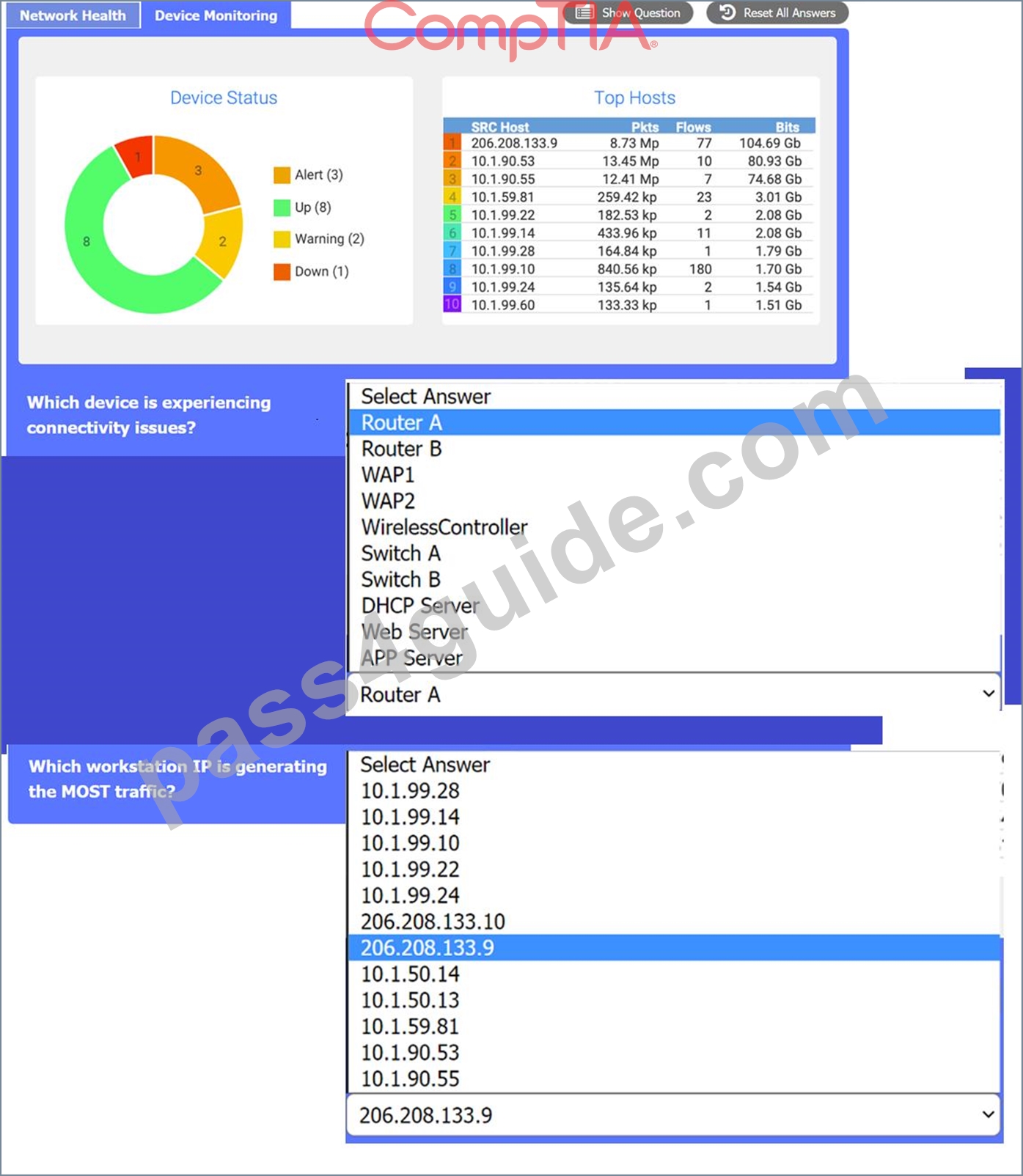
the device that is experiencing connectivity issues is the APP Server or Router 1, which has a status of Down. This means that the server is not responding to network requests or sending any dat a. You may want to check the physical connection, power supply, and configuration of the APP Server to troubleshoot the problem.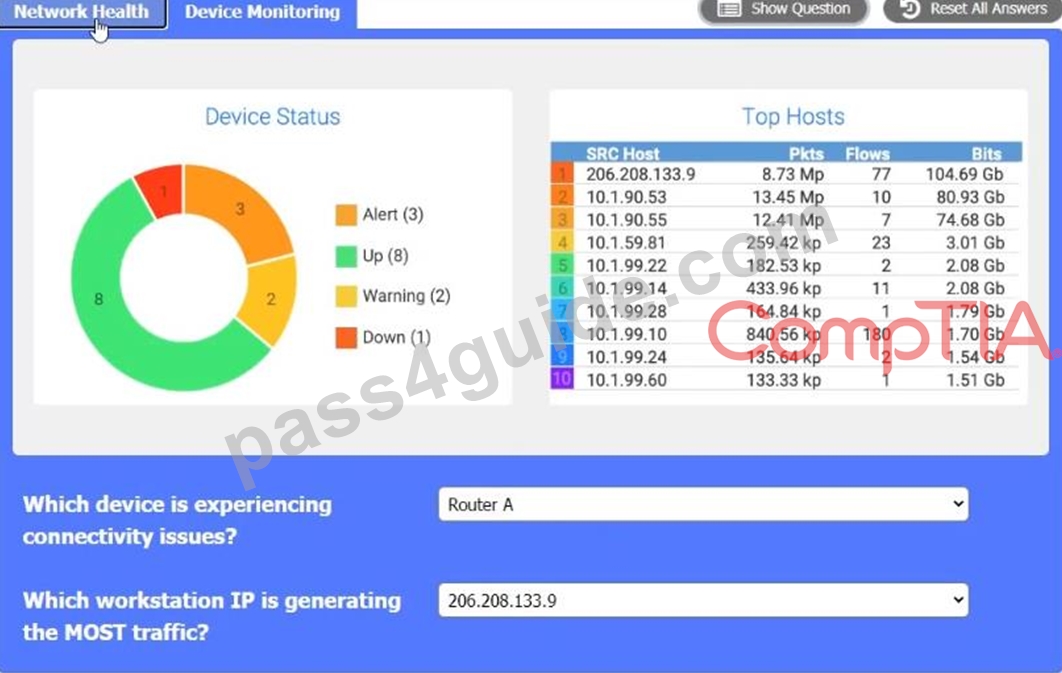
NEW QUESTION # 321
Which of the following compromises internet-connected devices and makes them vulnerable to becoming part of a botnet? (Select TWO).
- A. Deauthentication attack
- B. IP spoofing
- C. Dictionary attack
- D. Use of default credentials
- E. Malware infection
- F. Firmware corruption
Answer: D,E
Explanation:
A botnet is a collection of internet-connected devices that are compromised and controlled by hackers, often without the knowledge of the device owners. Hackers use botnets to launch various types of malicious attacks, such as distributed denial-of-service (DDoS), spam, phishing, crypto-mining, and more123.
To create a botnet, hackers need to infect the devices with malware that allows them to remotely control them and communicate with other infected devices. Malware can be delivered through various methods, such as phishing emails, malicious websites, drive-by downloads, exploit kits, and more12.
Therefore, one of the ways that compromises internet-connected devices and makes them vulnerable to becoming part of a botnet is B. Malware infection. Malware infection can affect any type of device that connects to the internet, such as computers, smartphones, tablets, routers, cameras, smart TVs, and more12.
Another way that compromises internet-connected devices and makes them vulnerable to becoming part of a botnet is E. Use of default credentials. Many internet-connected devices come with default usernames and passwords that are easy to guess or find online. Hackers can use these credentials to access the devices and install malware or change their settings12.
Therefore, another answer is E. Use of default credentials. Use of default credentials can affect any type of device that has a web interface or a remote login service, such as routers, cameras, printers, smart devices, and more12.
The other options are incorrect for the following reasons:
A . Deauthentication attack is a type of attack that targets wireless networks and devices. It involves sending spoofed deauthentication frames to disconnect the devices from the network or force them to reconnect. It does not compromise the devices or make them part of a botnet, but it can disrupt their communication or enable other attacks.
C . IP spoofing is a technique that involves forging the source IP address of a packet or a request. It can be used to hide the identity of the attacker, bypass security filters, or perform reflection or amplification attacks. It does not compromise the devices or make them part of a botnet, but it can make the attacks harder to trace or block.
D . Firmware corruption is a type of attack that targets the firmware of a device, which is the software that controls its basic functions and hardware. It involves modifying or replacing the firmware with malicious code that can damage the device, change its behavior, or allow remote access. It can compromise the devices or make them part of a botnet, but it is not a common or easy method, as it requires physical access or a specific vulnerability to exploit.
F . Dictionary attack is a type of attack that involves guessing passwords or encryption keys by using a list of common or likely words. It can be used to gain unauthorized access to accounts, devices, or data. It can compromise the devices or make them part of a botnet, but it is not a specific or efficient method, as it requires a lot of time and resources to perform. Reference:
1: What is a Botnet and How to Protect Your Devices in 2024 - VPNOverview.com
2: What is a botnet? When infected devices attack | CSO Online
3: What is a DDoS Botnet | Common Botnets and Botnet Tools | Imperva
4: Deauthentication attack - Wikipedia
5: IP spoofing - Wikipedia
6: Firmware - Wikipedia
7: Dictionary attack - Wikipedia
NEW QUESTION # 322
A network technician is troubleshooting a specific port on a switch. Which of the following commands should the technician use to see the port configuration?
- A. show interface
- B. show port
- C. show route
- D. show arp
Answer: A
NEW QUESTION # 323
A user notifies a network administrator about losing access to a remote file server. The network administrator is able to ping the server and verifies the current firewall rules do not block access to the network fileshare.
Which of the following tools would help identify which ports are open on the remote file server?
- A. dig
- B. nmap
- C. tracert
- D. nslookup
Answer: B
Explanation:
nmap is the tool that would help identify which ports are open on the remote file server. nmap stands for Network Mapper, which is a free and open-source tool that can perform various network scanning and discovery tasks. nmap can help identify which ports are open on a remote device by sending probes or packets to different ports and analyzing the responses. nmap can also provide information about the operating system, services, versions, firewalls, or vulnerabilities of the remote device. nmap can be useful for network administrators, security professionals, or hackers to monitor, audit, or attack network devices. References:
[CompTIA Network+ Certification Exam Objectives], Nmap - Free Security Scanner For Network Exploration
& Security Audits
NEW QUESTION # 324
A technician is installing multiple UPS units in a major retail store. The technician is required to keep track of all changes to new and old equipment. Which of the following will allow the technician to record these changes?
- A. An access control vestibule
- B. A camera
- C. A smart locker
- D. Asset tags
Answer: D
Explanation:
Asset tags will allow the technician to record changes to new and old equipment when installing multiple UPS units in a major retail store. Asset tags are labels or stickers that are attached to physical assets such as computers, printers, servers, or UPS units. They usually contain information such as asset name, serial number, barcode, QR code, or RFID chip that can be scanned or read by an asset management system or software. Asset tags help track inventory, location, status, maintenance, and ownership of assets. References:
https://www.camcode.com/asset-tags/asset-tagging-guide/
NEW QUESTION # 325
A company has experienced a major security breach. Which of the following should the network administrator reference to determine the next steps?
- A. Incident response policy
- B. Acceptable use policy
- C. Data loss prevention policy
- D. Non-disclosure policy
Answer: A
NEW QUESTION # 326
A technician reviews a network performance report and finds a high level of collisions happening on the network. At which of the following layers of the OSI model would these collisions be found?
- A. Layer 1
- B. Layer 7
- C. Layer 3
- D. Layer 4
Answer: A
NEW QUESTION # 327
A network administrator is implementing process changes based on recommendations following a recent penetration test. The testers used a method to gain access to the network that involved exploiting a publicly available and fixed remote code execution vulnerability in the VPN appliance. Which of the following should the administrator do to BEST prevent this from happening again?
- A. Change default passwords on internet-facing hardware.
- B. Create private VLANs for management plane traffic.
- C. Routinely upgrade all network equipment firmware.
- D. Implement robust ACLs with explicit deny-all entries.
Answer: C
Explanation:
Firmware is the software that runs on network equipment such as routers, switches, and VPN appliances. Firmware updates often contain bug fixes, security patches, and performance improvements that can prevent or mitigate vulnerabilities and attacks. By routinely upgrading all network equipment firmware, a network administrator can ensure that the network devices are running the latest and most secure versions of firmware and avoid exploiting known and fixed remote code execution vulnerabilities in the VPN appliance. Reference: https://www.comptia.org/training/books/network-n10-008-study-guide (page 462)
NEW QUESTION # 328
A technician is assisting a user who cannot connect to a website. The technician attempts to ping the default gateway and DNS server of the workstation. According to troubleshooting methodology, this is an example of:
- A. a top-to-bottom approach.
- B. a divide-and-conquer approach.
- C. a bottom-up approach.
- D. implementing a solution.
Answer: C
Explanation:
Pinging the default gateway and DNS server of the workstation is an example of breaking the problem down into smaller, more manageable parts. This is a bottom-up approach, which is a common troubleshooting methodology.
NEW QUESTION # 329
Users are reporting intermittent Wi-Fi connectivity in specific parts of a building. Which of the following should the network administrator check FIRST when troubleshooting this issue? (Select TWO).
- A. AP association time
- B. SSID assignment
- C. EIRP
- D. Captive portal
- E. Site survey
- F. AP placement
Answer: E,F
Explanation:
Explanation
This is a coverage issue. WAP placement and power need to be checked. Site survey should be done NEXT because it takes a while.
NEW QUESTION # 330
A network engineer is installing hardware in a newly renovated data center. Major concerns that were addressed during the renovation included air circulation, building power redundancy, and the need for continuous monitoring. The network engineer is creating alerts based on the following operation specifications: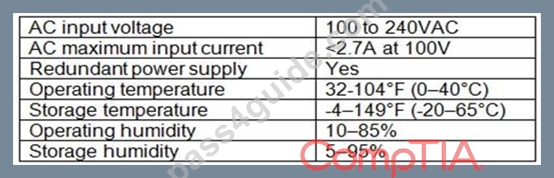
- A. SIEM to parse syslog events for a failed power supply
- B. SNMP traps to report when the chassis temperature exceeds 95°F (35°C)
- C. Environmental monitoring alerts for humidity greater than 95%
- D. UPS monitoring to report when input voltage drops below 220VAC
Answer: A
NEW QUESTION # 331
A client who shares office space and an IT closet with another company recently reported connectivity issues throughout the network. Multiple third-party vendors regularly perform on-site maintenance in the shared IT closet. Which of the following security techniques would BEST secure the physical networking equipment?
- A. Changing the default passwords
- B. Disabling unneeded switchports
- C. Implementing role-based access
- D. Configuring an access control list
Answer: C
Explanation:
Explanation
Role-based access is a security technique that assigns permissions and privileges to users or groups based on their roles or functions within an organization. Role-based access can help secure the physical networking equipment by limiting who can access, modify, or manage the devices in the shared IT closet. Only authorized personnel with a valid role and credentials should be able to access the networking equipment. Disabling unneeded switchports is a security technique that prevents unauthorized devices from connecting to the network by turning off unused ports on a switch. Changing the default passwords is a security technique that prevents unauthorized access to network devices by replacing the factory-set passwords with strong and unique ones. Configuring an access control list is a security technique that filters network traffic by allowing or denying packets based on criteria such as source and destination IP addresses, ports, or protocols.
References: CompTIA Network+ Certification Exam Objectives Version 7.0 (N10-007), Objective 3.2: Given a scenario, use appropriate network hardening techniques.
NEW QUESTION # 332
Which of the following types of attacks can be used to gain credentials by setting up rogue APs with identical corporate SSIDs?
- A. Evil twin
- B. Social engineering
- C. VLAN hopping
- D. DNS poisoning
Answer: A
NEW QUESTION # 333
Network traffic is being compromised by DNS poisoning every time a company's router is connected to the internet. The network team detects a non-authorized DNS server being assigned to the network clients and remediates the incident by setting a trusted DNS server, but the issue occurs again after internet exposure.
Which of the following best practices should be implemented on the router?
- A. Activate control plane policing.
- B. Disable router advertisement guard.
- C. Change the device's default password.
- D. Disable unneeded network services.
Answer: C
NEW QUESTION # 334
A network administrator needs to connect two network closets that are 492ft (150m) away from each other. Which of the following cable types should the administrator install between the closets?
- A. STP
- B. Single-mode fiber
- C. DAC
- D. Coaxial
Answer: B
NEW QUESTION # 335
A network technician is reviewing an upcoming project's requirements to implement laaS. Which of the following should the technician consider?
- A. Operating system maintenance
- B. Server hardware requirements
- C. Type of database to be installed
- D. Software installation processes
Answer: B
Explanation:
Explanation
IaaS stands for Infrastructure as a Service, which is a cloud computing model that provides virtualized computing resources such as servers, storage, and networking over the Internet. When implementing IaaS, the network technician should consider the server hardware requirements, such as CPU, RAM, disk space, and network bandwidth, that are needed to run the applications and services on the cloud. The other options are not relevant to IaaS, as they are either handled by the cloud provider or by the end-user. References:
https://www.comptia.org/blog/what-is-iaas
NEW QUESTION # 336
Given the following output:
Which of the following attacks is this MOST likely an example of?
- A. ARP poisoning
- B. Rogue access point
- C. Amplified DoS
- D. VLAN hopping
Answer: A
Explanation:
The output is most likely an example of an ARP poisoning attack. ARP poisoning, also known as ARP spoofing, is a type of attack that exploits the ARP protocol to associate a malicious device's MAC address with a legitimate IP address on a local area network. This allows the attacker to intercept, modify, or redirect network traffic between two devices without their knowledge. The output shows that there are multiple entries for the same IP address (192.168.1.1) with different MAC addresses in the ARP cache of the device. This indicates that an attacker has sent fake ARP replies to trick the device into believing that its MAC address is associated with the IP address of another device (such as the default gateway). Reference: https://www.cisco.com/c/en/us/about/security-center/arp-spoofing.html
NEW QUESTION # 337
An IT administrator received an assignment with the following objectives
* Conduct a total scan within the company's network tor all connected hosts
* Detect all the types of operating systems running on all devices
* Discover all services offered by hosts on the network
* Find open ports and detect security risks.
Which of the following command-line tools can be used to achieve these objectives?
- A. arp
- B. nmap
- C. netatat
- D. tcpdump
Answer: B
Explanation:
Explanation
Nmap (Network Mapper) is a free and open source command line tool that can be used to scan a network for all connected hosts, detect the types of operating systems running on all devices, discover all services offered by hosts on the network, find open ports, and detect security risks. Nmap is commonly used by system administrators and security professionals to audit a network's security and identify possible vulnerabilities.
Nmap can be used to discover active hosts, scan ports, fingerprint operating systems, detect running services, and more. Reference: CompTIA Network+ Study Manual, 8th Edition, page 592.
NEW QUESTION # 338
......
Get Instant Access REAL N10-008 DUMP Pass Your Exam Easily: https://www.pass4guide.com/N10-008-exam-guide-torrent.html
Practice with these N10-008 dumps Certification Sample Questions: https://drive.google.com/open?id=1tfH6zBzrgj-kfuzZJdPFMHLPgtkjv1r4